Get Full Government Meeting Transcripts, Videos, & Alerts Forever!
Get email alerts on the Xylazine Metatomidine Trends topic
No spam. Unsubscribe anytime.
Maryland health officials brief subcommittee on xylazine and metatomidine trends as scheduling debate continues
Summary
Department of Health officials told a legislative subcommittee April 3 that xylazine and metatomidine are increasingly detected in the illicit fentanyl supply, complicating overdoses and wound care; the committee held Senate Bill 447 and discussed whether scheduling would reduce harms or spur dangerous substitution.
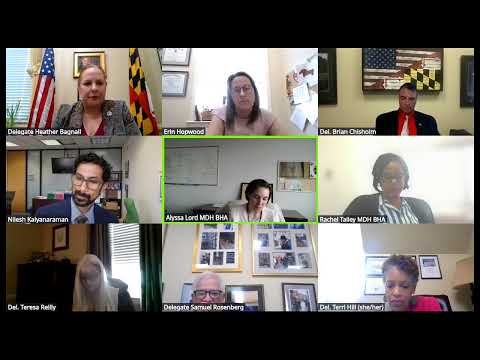
Maryland Department of Health officials told the Public Health and Minority Health Disparities Subcommittee on April 3 that xylazine and a newer veterinary sedative, metatomidine, are being detected repeatedly in the state's illicit fentanyl supply and are complicating clinical care and overdose response.
The briefing, presented by department staff including Dr. Kelly Onarone and Dr. Kalyana Raman, reviewed mortality and near-real-time surveillance and underscored that most xylazine-positive decedents also had illicitly manufactured fentanyl as the cause of death. "We saw a rise last year to 18.4 percent in 2024," Dr. Kelly Onarone said, citing the proportion of decedents who tested positive for xylazine. The department emphasized the preliminary nature of some numbers.
Why it matters: xylazine and metatomidine are veterinary sedatives not authorized for human use and are being mixed into street fentanyl. The drugs can worsen withdrawal, make detoxification and wound care harder, and may increase the severity of nonfatal harms even where total overdose deaths have recently trended down.
Key findings and department actions
- Mortality and surveillance: Dr. Onarone said overall overdose deaths have recently declined from prior peaks, but xylazine-positive decedent proportions rose to 18.4% in 2024 after a lower period in 2022'23. The department's Rapid Analysis of Drugs (RAD) program provides near-real-time sampling from syringe services participants but is convenience-based and not fully representative.
- RAD and sample results: The department reported that about 15.5% of RAD samples tested in Jan'Mar 2025 contained xylazine, a preliminary figure the presenters said represented a 48% decrease from the prior quarter and a 59% decrease versus the same period in 2024, while cautioning the sample is voluntary and subject to change.
- Harm reduction and treatment investments: Deputy Secretary Lord described expanded public education, wound-care training, distribution of more than 140,000 xylazine test strips to local overdose-response programs, a Johns Hopkins mobile drug-checking unit, increased telehealth and low-barrier care, and use of State Opioid Response and OD2A (Overdose Data to Action) resources to support surveillance and clinician technical assistance.
- Work group and testing capacity: The Xylazine in Maryland work group (formed 2021; report 2022, addendum 2023) prompted investments in testing protocols at the Office of the Chief Medical Examiner and staffing to analyze trends, the presenters said.
The scheduling debate
Committee members pressed the department on whether state scheduling (classifying a drug as controlled) would reduce harms. Dr. Kalyana Raman said much of the xylazine and metatomidine seen in the illicit supply appears to be illicitly manufactured and therefore may not be affected by scheduling: "Illicitly manufactured Xylazine isn't going to be impacted by this," she said, noting that scheduling primarily affects legally produced and distributed products and may drive substitution by other adulterants.
Metatomidine: a newer concern
The department described metatomidine as an emergent adulterant and said NIST and RAD testing has detected it in multiple jurisdictions. Dr. Kalyana Raman said metatomidine may be "about 200 to 300 times more potent than xylazine," raising concerns that scheduling xylazine in some states correlated with substitution by metatomidine elsewhere. The department said it had not identified fatal overdoses attributed solely to metatomidine but warned the compound's potency and withdrawal effects complicate treatment and clinical care.
Legislative questions and data gaps
Delegate Pippe said a chart he provided showed increasing xylazine-positive deaths and asked why that slide was not in the department's deck. Department presenters responded that they had pulled out xylazine-specific analyses and would follow up with additional slides and materials. Members asked whether nonfatal overdoses from these agents are being captured; the department said it would follow up with more information about nonfatal surveillance and earlier pilot urine-testing efforts.
What happens next
The subcommittee held Senate Bill 447 and did not vote; members asked the department for follow-up materials, more granular demographic and nonfatal data, and further discussion of possible legislative options to support surveillance, treatment, and interdiction. The department said it would continue RAD sampling, expand wound-care and harm-reduction supports, and coordinate with law enforcement and federal partners on source identification.
Quotes
"We saw a rise last year to 18.4 percent in 2024," Dr. Kelly Onarone said of xylazine-positive decedents. "Illicitly manufactured Xylazine isn't going to be impacted by this," Dr. Kalyana Raman said about the possible limits of scheduling. Deputy Secretary Lord described distribution of "more than 140,000 Xylazine test strips" to local programs.
Ending
The subcommittee concluded the briefing, asked for follow-up data and materials from the department, and adjourned to its regular committee meeting. No vote was taken on scheduling during the briefing; members signaled interest in further study of data, nonfatal surveillance, and whether legislative steps could be targeted to support public health and interdiction efforts.