Henry County hearing exposes split over proposed 598‑acre PUD for tech park and data centers
Loading...
Summary
At a Knightstown public hearing, residents and experts contested a proposed Planned Unit Development that would rezone roughly 598 acres for a technology park. Opponents raised water, noise, legal and fiscal concerns while developers and unions highlighted voluntary restrictions, paid utility upgrades and local jobs.
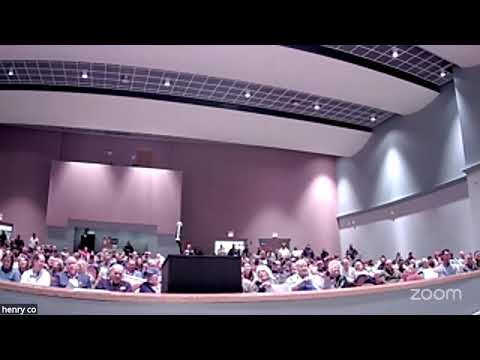
Knightstown — Commissioners heard more than two hours of public testimony Tuesday as residents, municipal experts, union representatives and the project's developers debated a proposed Planned Unit Development that would rezone roughly 598 acres at Exit 115 on Interstate 70 for a Henry County Technology Park and potential data‑center or advanced manufacturing uses.
The hearing centered on whether the county should approve an outline plan and PUD zoning that developers say adds protective guardrails up front — including a prohibition on on‑site groundwater wells and open‑loop cooling — and requires the petitioner to pay utility upgrades. Opponents said the PUD lacks essential details on water demand, noise and legal consistency with the county comprehensive plan.
"The planned unit development document makes repeated references to advanced water technologies yet provides no meaningful specifics," said Andrea Engleking, one of the first public commenters, arguing the PUD "fails to identify any cooling or water management system, estimated daily or peak water demand, or include binding commitments governing how water will be used." Engleking warned that local unconsolidated aquifers are "vulnerable to contamination," including PFOS, and said approving zoning before those studies would be risky.
Developer Greg Martz, representing GM Development and Surge Development, said the PUD intentionally sets restrictions that go beyond the county's base I‑2 code. "First, no on‑site wells and no open loop cooling system," Martz told the commissioners, describing guardrails that also include a requirement that the developer pay for 100% of on‑site water, wastewater and power upgrades, 25% permanent open space, 300‑foot setbacks and a 120‑foot landscaped perimeter buffer.
Martz emphasized the PUD is an outline zoning request, not approval of any particular company, saying, "we have not had substantive conversations with any data center users or manufacturing users." He added the PUD contains an 18‑month limit: if a development plan is not submitted within that period, the zoning would revert to agricultural use.
Opponents raised legal and procedural objections. "Approving this PUD creates immediate legal liability for Henry County because it violates your comprehensive plan," said Cody Smith, who cited state and county code language and urged commissioners to deny the application. Attorney Lorraine White, speaking for remonstrators, said she provided a 22‑page remonstrance and exhibits and asked the board to find the application noncompliant with specific sections of the Henry County zoning ordinance.
Speakers on both sides also disputed the project's likely economic and fiscal effects. Justin Lynch, a former educator, noted that Indiana school funding is tied to enrollment and county property‑tax caps limit what growth can translate into classroom dollars, saying the data center "does not increase instructional funding unless it brings in new students." By contrast, union leaders and tradespeople argued the project would supply long construction runs and apprenticeship opportunities: Sean Beatty of Laborers Local 1112 described paid internships and "700 jobs for the next 10 years" as transformative for local career training.
Industry speakers described modern cooling designs as far less water‑intensive than older facilities. Paul Amber, who works at an operating high‑power compute facility, said his site’s highest usage month was about 41,000 gallons and much of that is for closed‑loop maintenance activities that can be recovered and reused.
Other recurring concerns included low‑frequency noise impacts on nearby residents and wildlife, potential effects on prime farmland, and the question of who would bear the cost of grid upgrades. Residents asked for enforceable, measurable limits and for any promises to be tied to permitting and development‑plan approvals rather than informal assurances.
No formal vote was taken at the public hearing. Commissioners and county staff said the PUD and associated materials will remain public record and that further review — including planning commission consideration of any development plan, technical studies (water, wastewater, stormwater, utilities, air quality), and subsequent local, state and federal permits — would be required before any facility could be built.
The board did not adopt or reject the PUD during the session; the next steps include internal staff review and a future agenda item for the commissioners to deliberate and vote. Those materials, including the petition packet and remonstrance, were available to the board and may be requested through the county courthouse public records process.