
New Maryland Department of Social and Economic Mobility outlines start-up plan, warns federal DBE rule change could affect thousands of firms
Get AI-powered insights, summaries, and transcripts
Subscribe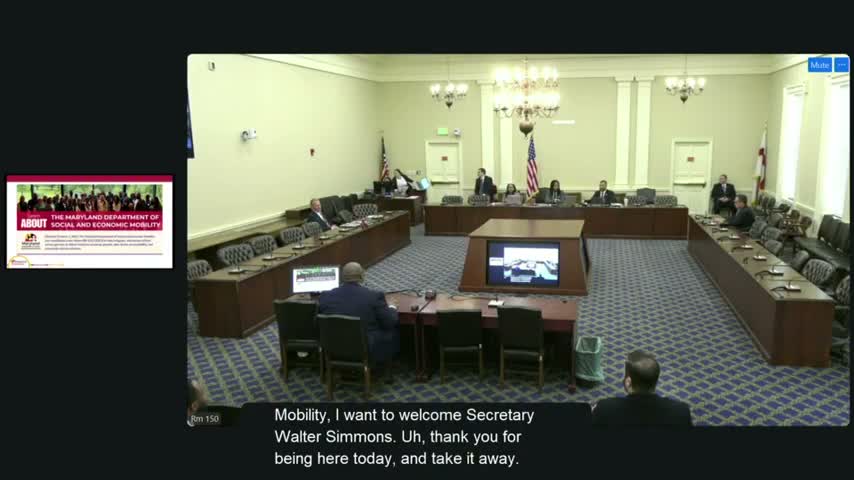
Summary
Secretary Walter Simmons briefed the Appropriations Committee subcommittee on the new Department of Social and Economic Mobility, describing office consolidations, outreach and a plan to help thousands of disadvantaged businesses required to refile documentation after a federal DBE rule change.
The Department of Social and Economic Mobility, created Oct. 1 and consolidated from three legacy offices, briefed the Public Safety and Administration Subcommittee of the Appropriations Committee on its first months of operation and steps to support Maryland businesses facing a federal certification shake-up.
Secretary Walter Simmons told the subcommittee that a federal change to the interim final rule for the Disadvantaged Business Enterprise (DBE) program, issued Oct. 3, removed race-based presumptions and will require every affected firm to resubmit personal narratives and net-worth documentation. He said Maryland accounts for roughly 18.5% of the national DBE program and that the change could affect an estimated 10–20% of certified firms — a population he described as “over 7,000 businesses in the state of Maryland.”
The briefing laid out why the department was created and how it is organized. Simmons said the department combines the Office of Social Equity, the Office of Small, Minority and Women Business Affairs (OSBA), and the Office of Minority Business Enterprises (OMBE), which previously operated under different state agencies. Simmons named senior staff in his office, including Chief of Staff Laura Gutierrez, Chief of External Affairs Arti Kamali and Policy and Legislative Director Davon Gardner, and said the Office of the Attorney General recently supplied a principal counsel to the new department.
Why it matters: The department is positioning itself not merely as a certification body but as a small-business competitiveness administrator. Simmons said the agency will pair certification with active supports — training, matchmaking with prime contractors, private-sector partnerships, and targeted regional outreach — to boost firms’ capacity to win contracts rather than only granting certification and leaving firms to compete alone.
Operational priorities and protections Simmons described five startup priorities: building organizational infrastructure (offices, IDs, furniture, staffing), putting in place operations and onboarding procedures, standardizing KPIs to align with House Bill 1253, conducting broad stakeholder engagement under an initiative called “Voices of Maryland,” and designing an economic mobility ecosystem focused on Maryland businesses, residents and communities.
On the immediate problem posed by the federal DBE change, Simmons said the department expects to require resubmission of documentation from every DBE-certified firm and that the Board of Public Works approved funding to bring on additional staff or contractors to review the wave of applications. He said the department will issue periodic guidance — noting they had received multiple rounds of federal guidance — and encouraged legislators and constituents to report problems to a department contact line for rapid triage.
Safeguards and capacity-building To reduce disruption, Simmons said the department has produced an internal implementation playbook, retained consultants (work first started under MDOT) to address turnover and processing delays, created staff leadership groups to preserve institutional knowledge, and onboarded contractors to increase processing capacity. He said the department will release OAG- and governor’s-office-reviewed guidance to the public in stages and keep contractors available to handle unforeseen issues.
Outreach and tools Simmons outlined regional strategies to increase Minority Business Enterprise (MBE) participation, including restructuring staff into regional teams, asking the state’s 72 funded entities to hold open houses, and hosting matchmaking events that pair agencies and prime contractors with certified firms by NAICS code. As an example, staff recently identified seven IT NAICS codes and 233 businesses to target for direct engagement. Simmons also said a staff member will begin a statewide mapping of capacity-building programs on Feb. 4 to build a library of supports.
Systems modernization Simmons said many functions remain manual — spreadsheets and paper — and that the department is coordinating with the Department of Information Technology (DoIT) and the Department of General Services (DGS) to explore combining platforms such as eMaryland Marketplace Advantage (EMA) and existing B2G systems to create a more unified experience for businesses and agencies.
Questions from committee members focused on how the legislature and department can support firms through the documentation resubmission process. A committee member who identified themself in the transcript as Delegate Julian Ivy asked how legislators might help businesses develop their personal narratives; Simmons said the department will provide direct outreach, district visits on request and channels for constituents to report problems as review capacity ramps up.
The meeting concluded with committee members thanking Simmons and his team and expressing a desire to work with the new department to address disparities in contracting and economic opportunity.
Closing note: The briefing included several numeric and timeline details provided by Simmons (for example, the 7,000+ figure for affected firms, a cited 10–20% estimate for potential loss of certification, and a Feb. 4 staff start date). These are reported as stated by department leadership in the subcommittee briefing.