Get Full Government Meeting Transcripts, Videos, & Alerts Forever!
Get email alerts on the Vision2050 Compplan Review topic
No spam. Unsubscribe anytime.
Pitkin County planning commission reviews Community & Economic Health and regional policies in Vision 2050 draft
Summary
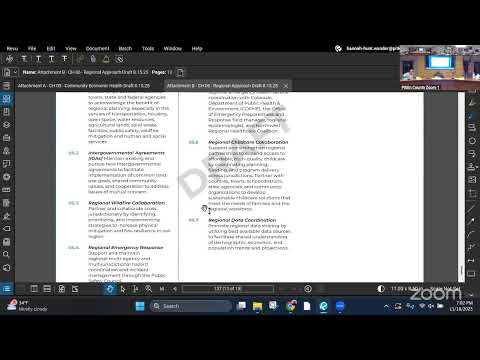
At a Nov. 18, 2025 Pitkin County Planning & Zoning Commission work session, staff and commissioners reviewed the Community & Economic Health and Regional Approach chapters of the Vision 2050 draft, debating education, critical community services, workforce pipelines, hazard mitigation and watershed framing.
Pitkin County planners and commissioners met Nov. 18 to review two chapters of the Vision 2050 draft comprehensive plan, focusing on Community & Economic Health and the Regional Approach. Hannah Hunt, a long-range planner with Pitkin County, led the discussion, saying the chapter seeks to “promote and support both social as well as the economic well-being” as part of a 2050 vision that emphasizes climate action, rural-land preservation and equitable affordability.
Commissioners and staff framed the chapters as implementation-oriented guidance ahead of a referral process to caucuses, municipalities and the Board of County Commissioners. Staff said housing policy language has been consolidated into the housing chapter and that the current review is intended to capture clarifications and implementation priorities before a December 16 meeting and January referrals.
A key point of debate was education and workforce supports. One commissioner said K–12 education is under-emphasized and urged the plan to explicitly include it; staff agreed to call out K–12 where appropriate. Commissioners also pressed to strengthen language on “critical community services” for roles such as health workers, first responders, educators and public-service positions, arguing these are essential to sustain local services over the plan’s 25-year horizon.
Housing repeatedly surfaced as central to workforce retention. Commissioners noted that without housing availability for essential workers, policies for economic diversification and workforce pipelines will fail to deliver intended outcomes. Staff acknowledged homelessness and housing access need clearer references and said housing-related policies reviewed in October will be integrated into the final package.
Public-safety and emergency-response policy also drew extended discussion. Staff tied plan language to the county’s hazard mitigation and emergency-operations plans and told the commission that emergency communications and evacuation policies were shaped by recent public input. Commissioners debated how specific the comp plan should be about day-to-day operations (code enforcement, snowplow drivers, deputies) versus high-level policy direction; staff said the plan should set policy without attempting to dictate every operational detail.
Commissioners emphasized the county’s seasonally variable population and peak-load challenges: staff noted that full-time population projections are modest but that tourism and special events drive service-intensity spikes requiring targeted planning. Several commissioners recommended clearer implementation language that links policy priorities to staffing, funding and interagency coordination.
On economic sustainability, staff summarized policies for economic resilience, diversification, workforce development and local-business support, and commissioners encouraged stronger emphasis on strategic partnerships and on supporting returning residents and local training pipelines.
Staff said the next steps are to return to the Planning & Zoning Commission on Dec. 16 with an implementation-priorities matrix and updated policy text. The draft plan will then be formally referred to caucuses, municipalities and land managers in January ahead of the public hearing and final BOCC consideration.
The commission closed the session with direction to staff to clarify references to education and critical community services, to tighten linkages between policy and implementation, and to coordinate watershed and water-policy language with legal and water-management partners.