Get Full Government Meeting Transcripts, Videos, & Alerts Forever!
Get email alerts on the Wildfire Resiliency Code Adoption topic
No spam. Unsubscribe anytime.
Pitkin County staff preview adoption of Colorado Wildfire Resiliency Code; public hearing set for Feb. 25
Summary
Pitkin County on Jan. 27 held a public webinar on adopting the Colorado Wildfire Resiliency Code into the county building code, outlining major changes — statewide intensity mapping, new structure-hardening rules, ground-truthing procedures and defensible-space adjustments for steep slopes — and a timeline for hearings Feb. 25 (first reading) and Mar. 25 (second reading).
Pitkin County staff on Jan. 27 walked residents through proposed local adoption of the Colorado Wildfire Resiliency Code (CWRC), saying the Boulder-to-state timeline calls for a first reading and public hearing Feb. 25 and a second reading on Mar. 25 with the code required to take effect no later than July 1, 2026.
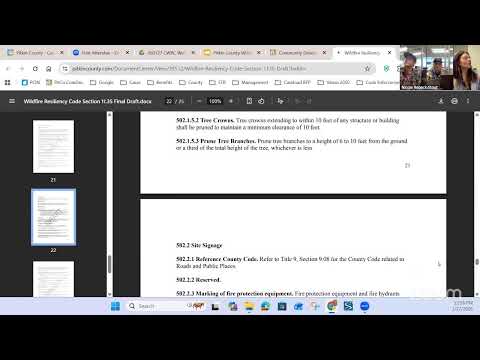
Nicole Rebeck Stout, deputy director of the county’s Community Development Department, and Jeff Erickson, Pitkin County’s chief building official, said the county will insert the state-mandated CWRC provisions into a new building-code section (11.35) so the requirements apply to building permit applications submitted on or after the local effective date. "The code must take effect, 07/01/2026," Erickson said, noting that if the Board of County Commissioners approves the ordinance after its second reading it will typically take effect about 30 days after notice.
Why it matters: The CWRC replaces local wildfire-intensity mapping with a statewide wildfire-intensity map and brings new, prescriptive structure-hardening and site standards into the building code. That means more specific material, glazing, roof and underfloor requirements will apply at permit review for projects in mapped moderate or high intensity areas. Pitkin County staff said, under current CWRC mapping, the county has no low-intensity areas mapped and therefore most unincorporated parcels would fall under the more stringent class 2 requirements unless a property successfully obtains a site-specific ground-truthing determination.
Key changes staff highlighted include thresholds that trigger compliance on existing buildings (for example, replacing 25% or more of an exterior roof covering, or altering 25% or more of an exterior wall surface, requires bringing the affected assembly into compliance); a new set of acceptable exterior materials (noncombustible, fire-retardant-treated wood, or ignition-resistant materials); tighter vent-screen openings (moving from 1/4-inch to 1/8-inch in some cases); and expanded glazing options (multilayer glazing or products rated to resist exposure for a specified time rather than only tempered glass).
Exemptions and local amendments: Staff clarified limited exemptions. Detached accessory nonhabitable structures under 120 square feet and located at least 10 feet from the nearest occupiable structure are exempt from CWRC requirements. The state model also includes an agriculture exemption; Pitkin County’s draft amendments do not fully exempt agricultural structures. Instead, county staff said they plan to reduce requirements for certain agricultural buildings if they meet siting criteria (for example, set back sufficient distance from habitable buildings and property lines).
Ground truthing and professional standards: The CWRC includes a ground-truthing process — a site-specific wildfire analysis that can confirm or change a mapped intensity classification. Nicole Rebeck Stout said staff prefer that ground-truthing occur during planning review so developers and planners know what will apply at the building-permit stage, and that fire districts will determine acceptance of ground-truthing reports. Jeff Erickson added the model code does not define a "qualified wildfire professional," so acceptance of particular experts will be determined locally by the code official and the fire jurisdiction.
Defensible space and slopes: The CWRC uses three defensible-space zones (immediate 0–5 feet, intermediate 5–30 feet, and expanded up to 100 feet). Pitkin County staff and the fire districts recommended expanding zone 2 (the intermediate zone) to 100 feet for sites with downhill slopes over 30% or where development is upslope, and preserving a smaller zone where there is no upslope development. The county also added guidance for driveways and forest-management typologies to account for local ecosystems such as aspen stands and shrublands.
Questions from the public and staff responses: Attendees raised concerns about insurance market impacts and whether insurers helped develop the map. "The state assured us that the insurance companies are not using this map for insurance purposes," Rebeck Stout said, and she offered to connect residents to state contacts for more detail. Other public questions covered ground-truthing scope, whether existing wildfire consultants will qualify to prepare reports, treatment of federal lands shown on the map (staff said those parcels are outside local jurisdiction and county attorneys are reviewing the implications), and technical questions about underfloor enclosures and deck construction.
What’s next: Draft building- and land-use-code amendments are posted on the county’s active projects web page and staff are accepting comments and holding office hours. Pitkin County will hold a first reading and public hearing before the Board of County Commissioners on Feb. 25; the hearing record will be continued to a second reading on Mar. 25, where staff hope to adopt the codes. Staff said more details about ground-truthing, the qualified-professional process and development-services intake procedures will be published before those hearings.
The webinar recording and the draft code documents are available on the county website. Residents who wish to comment at the Feb. 25 hearing were invited to attend the public hearing or to submit written feedback in advance.