
Winchester School Committee outlines FY27 budget priorities in $77.33M 'state of the town' request
Get AI-powered insights, summaries, and transcripts
Subscribe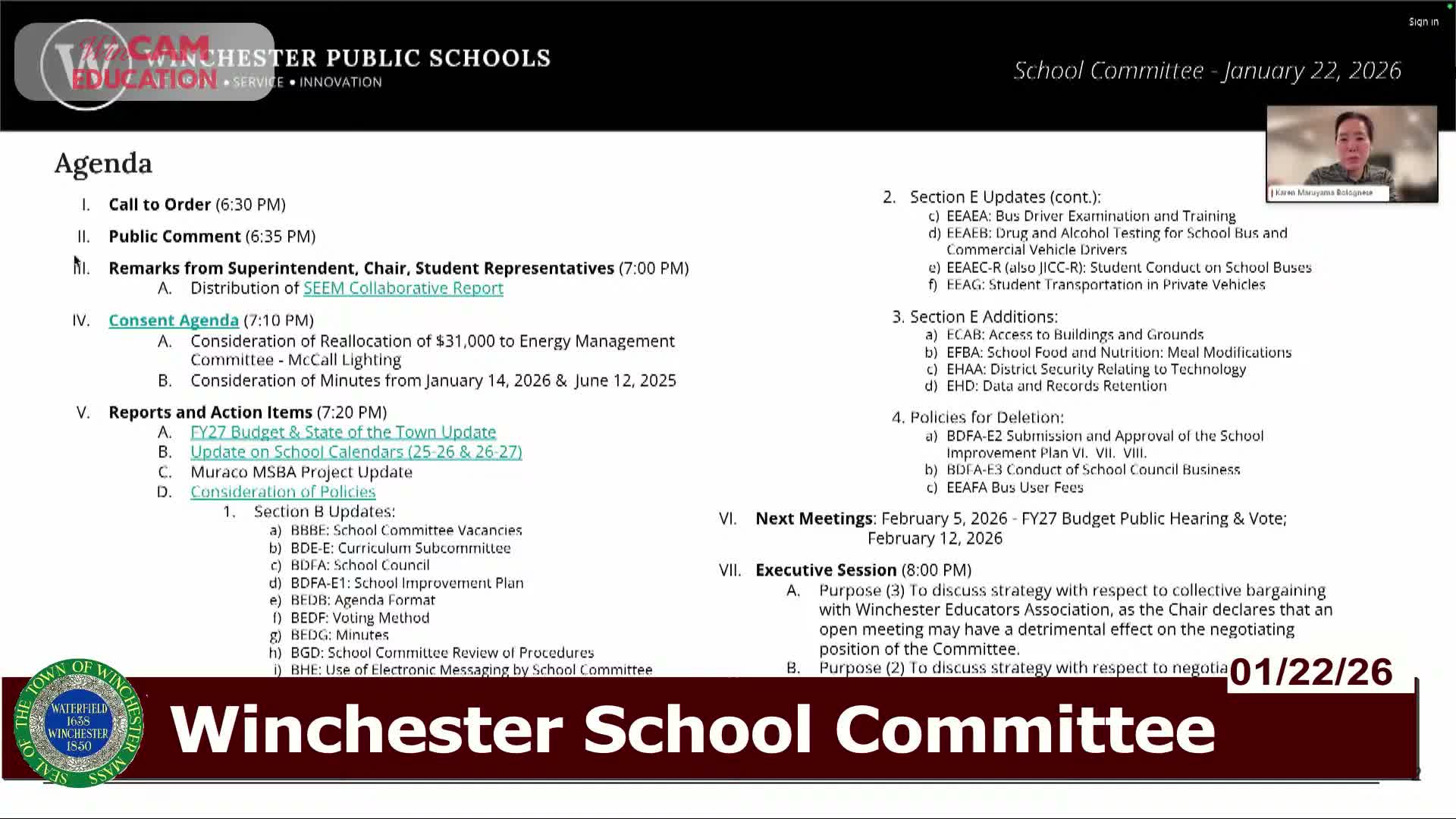
Summary
Committee reviewed the superintendent-recommended FY27 budget under a level-services model plus 'essential services,' showing a state-of-the-town figure presented around $77.33 million (about 9.82% including the 5% rollover). Priorities include tier 2 supports, special education, high-school scheduling/capacity and equity investments; the committee scheduled a budget summit Jan. 28 and a public hearing Feb. 5.
The Winchester School Committee on Jan. 22 reviewed the superintendent-recommended FY27 budget and the "state of the town" model that the district presented to the select board.
District leaders described a level-services base (a 5% rollover growth) and an additional "essential services" ask that produced a state-of-the-town figure the presentation listed at roughly $77,331,000 (presented as about a 9.82% figure inclusive of the 5% level-services amount). Committee members said the essential-services requests total approximately $3,395,000 and are grouped into curriculum updates (math and literacy), expanded tier 2 supports, and equity work across the five elementary schools.
Presenters listed major budget drivers: five collective bargaining units (unit A teachers were voting on ratification), special-education tuition and transportation, general-education transportation, recently added ESP positions, substitute costs, retirements, and enrollment-driven needs. Several members stressed that structural deficits exist in athletics and that some current-year costs (notably special-education transportation) will create a gap the district is managing into FY27.
The budget subcommittee reviewed timeline changes: a budget summit with town boards is scheduled Jan. 28, the School Committee public hearing was moved to Feb. 5, and a special town meeting on Feb. 9 could address an override and any debt-exclusion or model the select board brings forward.
Committee members and staff discussed contingency planning if an override fails, including preparing a level-funded budget as a baseline scenario. Members asked staff to continue modeling scenarios and to bring clarifying materials to upcoming subcommittee meetings; staff said they expect the committee to vote on the budget at its Feb. 5 meeting.
No formal operating budget vote was taken Jan. 22; members agreed to continue work at budget-subcommittee meetings and to brief the full committee after the Jan. 28 summit.