
School district reports 52 HIB investigations, majority founded; appearance (fat‑shaming) most cited
Get AI-powered insights, summaries, and transcripts
Sign Up Free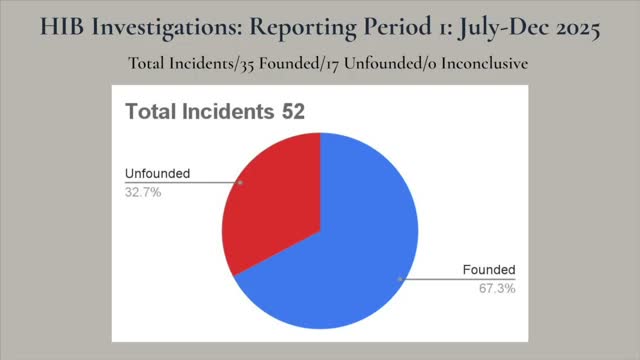
Summary
District anti‑bullying coordinator reported 52 investigations for July–Dec 2025 with 35 founded; appearance (primarily fat‑shaming) was the largest distinguishing characteristic. The board accepted the semi‑annual report after discussion about data, restorative practices and parent outreach.
Dr. Jessica Smedley, the district’s anti‑bullying coordinator, told the West Windsor‑Plainsboro Regional School District Board of Education that the district opened 52 HIB (harassment, intimidation and bullying) investigations for July–Dec. 2025 and found 35 to be founded.
Smedley said the district used a new preliminary‑determination step added in 2024 to give principals discretion to screen reports before a full HIB investigation. "We now are using preliminary determination," she said, and credited the change with producing fewer inconclusive cases in this reporting period.
The report showed K–5 had the largest share of founded incidents (24), grades 6–8 had 22 and grades 9–12 had six. By location, Smedley said 42.3% of founded incidents occurred in classrooms; playgrounds and school buses each accounted for about 13.5%. "Classroom reporting is often higher in K–5 because teachers file reports on behalf of younger students," she said.
Smedley identified appearance as the most common distinguishing characteristic (38.5%), which she described as "almost exclusively fat‑shaming," followed by ancestry (13.5%). Race and ethnicity each accounted for about 9.6%, and disability 1.9%.
She described several patterns the district is monitoring: a spike in October that she tied to heightened awareness and reteaching, nested or retaliatory incidents that emerge during investigations, and the influence of social media and games on off‑campus behavior. "We are seeing that locally here as well," she said, noting that internet exposure can prompt younger students to repeat slurs and taunts they see online.
Smedley outlined the district’s tiered prevention and response system: K–5 lessons (Second Step), middle/high school SEL materials (Wayfinder), monthly anti‑bullying meetings, culture and climate teams, counselor‑led interventions, and restorative practices for both victims and offenders. She said anti‑bullying specialists are typically school counselors who bring data to school counseling meetings and climate teams to inform lessons and school events such as a recent DeStress Fest.
Board members asked for clarifications about categories (Dana) and whether distinguishing characteristics were aggregated by grade band (Ajanta). Smedley said she had grade‑band breakdowns but had not brought them to the presentation, offering an anecdotal observation that fat‑shaming is concentrated in upper elementary grades.
The board moved to accept the district’s July 1–Dec. 31, 2025 semi‑annual HIB report as required under the New Jersey Anti‑Bullying Bill of Rights Act; the motion (moved by Liz, seconded by Loy) passed by roll call and the special HIB hearing was adjourned.
The next steps Smedley described include continuing restorative practices, parent outreach (PTSA parent universities), and coordination with an interagency task force referenced in the presentation to broaden prevention efforts beyond schools.
Ending: The board accepted the semi‑annual report and closed the special public hearing; staff will continue monthly data reviews and district‑wide prevention programming.