Lifetime Citizen Portal Access — AI Briefings, Alerts & Unlimited Follows
Spokane County outlines parks element for 2046 plan, highlights levels of service, funding and West Plains gap
Loading...
Summary
County planning staff described park classifications, acreage and funding sources and said drafts of plan chapters will be released starting in January for public and agency review; staff cited a 1.4-acres-per-1,000 urban standard and a recent 10-acre acquisition to address a West Plains deficit.
Spokane County planning staff on a recorded lunchtime briefing outlined how the parks and open space element will fit into the county’s Comprehensive Plan 2046 and described park classifications, funding sources and level-of-service standards.
Scott (planning staff) said the parks element sits alongside capital facilities planning and the parks department’s operational plan and that the Growth Management Act provides the statutory foundation for comprehensive planning in Washington state. “Parks is an optional element,” Scott said, but he emphasized the county has long included parks and a range of supporting documents to guide investment and operations.
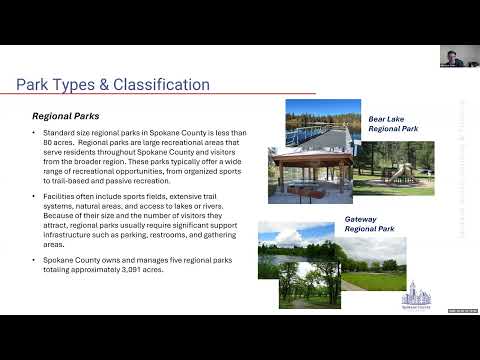
Jonathan Smith of the Spokane County Parks Department described three park categories: community parks (roughly 10–20 acres with playgrounds and courts; the county has about 13), regional parks (larger properties with trails, water access and multiuse opportunities; about 3,000 acres across five parks) and open space/natural areas (trailheads and conservation areas; the county said it has over 8,000 acres of these lands). Jonathan also noted the Conservation Futures program has been a major acquisition tool.
On funding, Jonathan said the Conservation Futures levy is the most stable revenue source for parks and that policy allocates roughly 75% of levy proceeds to land acquisition and 25% to maintenance operations. He listed other revenue sources including general fund allocations, real estate excise tax for grant matching, refunds tied to acquisitions and competitive grants for acquisition and capital projects.
The county uses coordinated capital-facilities and park-plan metrics to evaluate urban service. “We…identify if we have a deficiency,” Jonathan said, describing an urban level-of-service standard of 1.4 acres of community parkland per 1,000 residents inside urban growth areas and a 3-mile access consideration for concentrated areas. He cited the West Plains as an identified deficiency where the county acquired 10 acres and developed the Camas Prairie Park off Melville Road to help close the gap. For rural areas, Jonathan said the county uses a rural target of 160 acres per 1,000 rural residents and that the county generally meets that standard because of its large open-space holdings.
Scott said many existing comprehensive-plan policies date to 2001 and need review to reflect contemporary growth, and he described a legislative change to an update cycle now on a 10-year schedule with a 5-year progress report. Staff said they will align departmental planning horizons and work to make policies measurable so the county can track and defend levels of service.
On public engagement, Scott told meeting participants that draft chapters will be released starting in January for agency and public review and that staff plan to knit chapters into a draft comprehensive plan by April–May while continuing outreach. When asked whether the county will solicit early comments, Scott replied: “Yes, we will be asking for early and often comments both from agencies such as yours and, through public participation and in place open houses.” He also announced upcoming open houses and a February session on natural environment areas. Scott said the session was recorded and would be posted to the county’s YouTube channel.
The briefing provided an overview of how parks planning, funding and service standards will be reviewed as part of the 2046 Comprehensive Plan process and signaled a schedule for draft releases and public review early next year. The county encouraged agencies and the public to provide feedback as chapters become available.