State work group urges standardized mental health advance directives, better storage and training
Loading...
Summary
A presenter to the Spokane Regional Behavioral Health Advisory Board summarized 2025 work-group recommendations to mainstream Mental Health Advance Directives (MHADs): a centralized repository, interoperable access (with role-based privacy), and training toolkits prioritizing plain language, equity and conflict-of-interest safeguards.
Kim Taylor, chair of the Spokane Regional Behavioral Health Advisory Board, opened the meeting and introduced a presentation on Mental Health Advance Directives (MHADs) delivered by Gail Kogel, who participated in a state work group convened under Second Substitute Senate Bill 560.
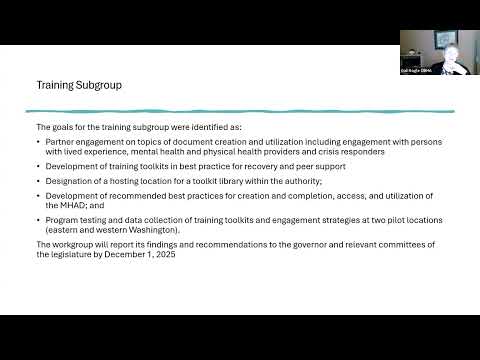
Kogel said the work group—formed after the 2024 law directing the Health Care Authority to develop implementation recommendations—split into two subgroups: document storage and training for creation and use. She told the board the storage subgroup prioritized a reliable, interoperable repository so MHADs are available during crises, and the training subgroup focused on toolkits and community engagement to increase provider and peer support understanding.
The work group recommended a centralized repository that supports role-based access (to protect privacy) and interoperability with clinical records so a person’s MHAD can be retrieved by responders or treating clinicians. Kogel noted pilot testing for a focused repository and emphasized maintaining the form’s integrity so electronic-health-system fields do not truncate a person’s stated preferences.
On training, Kogel said the recommended toolkits should include plain-language materials, multilingual options, role-play demonstratives, and ethical guidance to reduce conflicts of interest when peers or agency staff facilitate MHAD creation. She said partners for training should include people with lived experience, clinicians and crisis responders.
Kogel reviewed the current, fillable MHAD form the group examined and suggested adding fields for preferred name and pronouns. She walked through key sections—treatment preferences, medications to accept or refuse, consent for voluntary admission, designation of an agent with authority to sign releases and consent to treatment, and preferences about seclusion, restraint and emergency medications.
Kogel also raised practical barriers: inconsistent use of older notarized or witnessed forms, ROI (release-of-information) expirations that can prevent agents from accessing records across hospitalizations, staff turnover that erodes local MHAD knowledge, and provider liability concerns. She said the group aimed to report recommendations to the legislature and governor by Dec. 1, 2025, and that the Health Care Authority’s web page hosts updated MHAD resources.
Board members asked when they should expect further updates and whether the form Kogel showed was the most current; Kogel pointed to the March 2025 update and offered to share slides and materials with the group. She urged community education and phased implementation to support equitable access and privacy protections.
The board did not take formal action on the recommendations during the meeting. The next procedural step Kogel listed was piloting repository features, producing cost estimates and developing a statewide training and engagement plan.