Get Full Government Meeting Transcripts, Videos, & Alerts Forever!
Get email alerts on the Curb Ramps topic
No spam. Unsubscribe anytime.
Public Works outlines plan to repair 9,700 substandard curb ramps; requests $10M for FY25'26
Summary
San Francisco Public Works presented its curb ramp inventory (about 42,000 locations), described 9,731 ramps needing attention, and requested $10 million for FY25'26 to increase annual production toward a 10-year saturation goal.
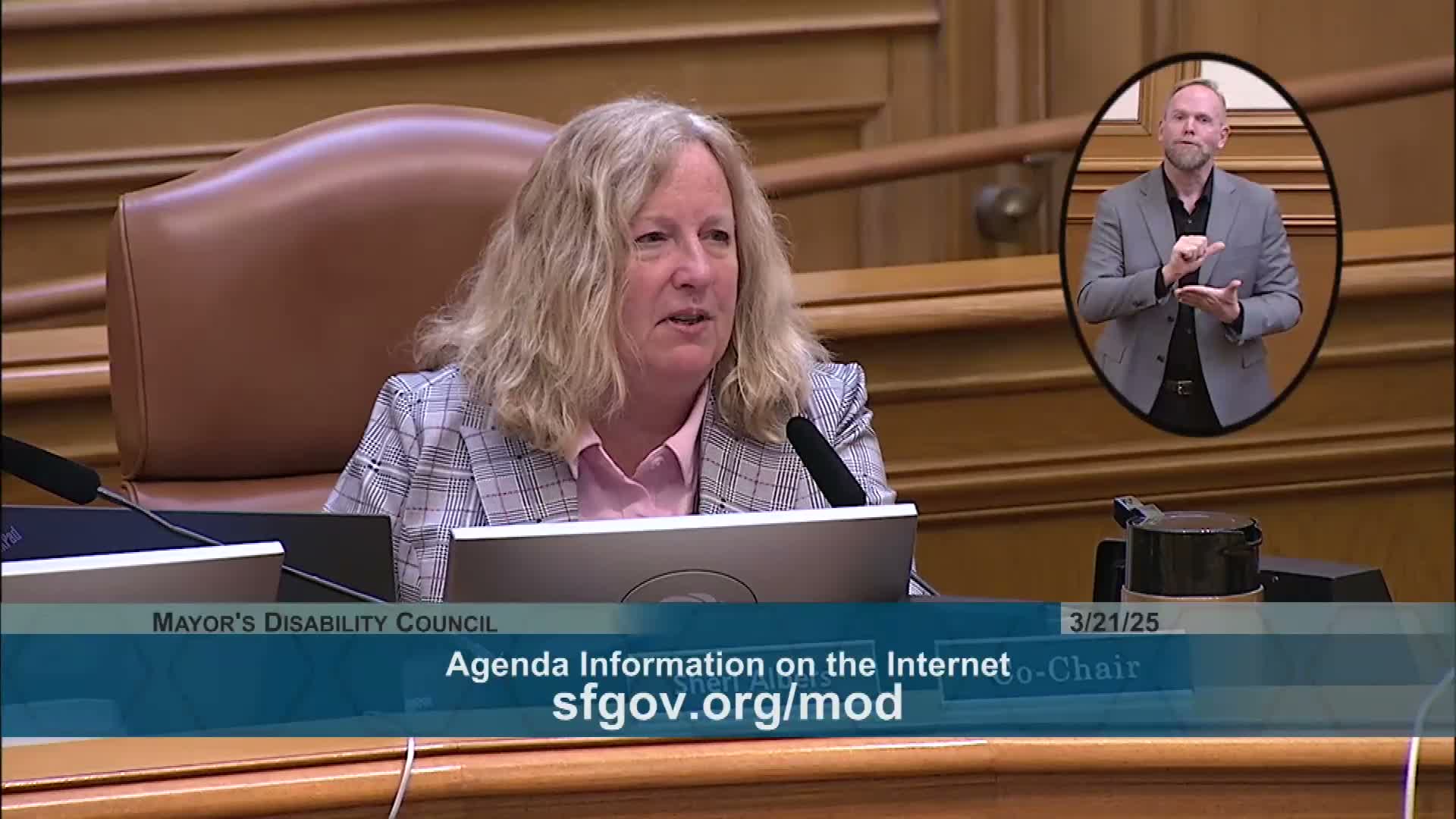
San Francisco Public Works briefed the Mayor's Disability Council on March 20 about the city's curb ramp program, inventory and funding needs. Anastasia Haddad, curb ramp program manager, said the city tracks roughly 42,000 curb ramp locations and categorizes them as Good, Fair, Poor or No Ramp (buildable). The program's target to reach full saturation is to reconstruct or install about 9,731 deficient ramps.
Haddad said that over the past five years the city and partner agencies built roughly 4,300 curb ramps and that FY24'25 funding to the program is $5.3 million; the program projected to complete about 168 ramps this fiscal year. For FY25'26 Public Works requested $10 million and set a target of 290 ramps next year. To reach the 10-year saturation goal by 2035, the program estimates it needs to perform roughly 300'400 ramps per year from the city's program alone (other agencies also contribute).
The presentation listed eight prioritization criteria: number of requests per location, existence of a path of travel, high-injury network designation, condition of the existing ramp, direct request by a person with a disability, geographic equity and district request counts. Haddad said unresolved community requests total about 4,300 and that Districts 3, 5, 6 and 7 showed higher concentrations due to underground utilities and sub-sidewalk basements that increase cost and complexity.
Council members and the public asked operational questions about timeline (a standard curb ramp construction is typically about a month), repair versus full reconstruction (some ramps are salvageable; others require full rebuild) and which departments handle related sidewalk or tree-root issues (Bureau of Urban Forestry for uplift; SFMTA when traffic-signal poles are involved). Haddad said funding and staff availability are the program's principal constraints.
Public Works asked the council and community to support the program at the Capital Planning Commission and to help route citizen requests through 311 or MOD so they reach the program.