Get Full Government Meeting Transcripts, Videos, & Alerts Forever!
Get email alerts on the Housing Development topic
No spam. Unsubscribe anytime.
Developer halts 100‑unit Valley Cove project, citing $15 million shortfall and permitting hurdles
Summary
A proposed 100‑unit Valley Cove development in Marysville stalled after the developer said soft costs and an estimated $15 million funding gap left the project infeasible; participants at a Perry County housing work group discussed financing, grant timing and municipal zoning barriers.
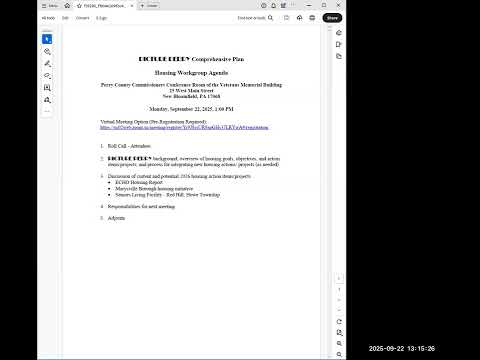
Jason Finnerty, Perry County planning coordinator with the Tri County Regional Planning Commission, convened a virtual housing work group that heard from a developer who said a proposed Marysville project proved financially and administratively unworkable.
Tara, a local realtor and developer who led the Valley Cove effort, said the plan called for roughly 100 units — a mix of elderly housing and townhomes on about 12 acres — but she abandoned the contract after paying about $20,000 in schematic and feasibility costs and finding an estimated $15 million budget shortfall with a roughly $5 million contingency. "I had to scrap the contract with the paces, because it wasn't going to be able to have the time I needed to make sure that $15,000,000 that I was gonna go have to find," she told the group.
Why it matters: attendees said the episode illustrates common obstacles to building affordable housing in Perry County — high upfront soft costs, lenders relying on conservative appraisals, and grant programs whose award timing does not align with private financing commitments.
Key details and constraints
Tara told the meeting she had spent about $20,000 on schematics and soft costs and had a $5,000 initial holding payment on the parcel. She described a financing gap created when a lender would only lend to the appraised value, leaving the developer to cover the shortfall ahead of any grant awards. She said those combined upfront costs and timing risks made the Marysville deal infeasible.
Meeting participants discussed options to reduce those barriers: pursuing more targeted grant support for soft costs, coordinating county-level assistance for grant writing, and seeking municipal zoning flexibility for temporary or mixed‑use solutions. Jason Finnerty noted that some boroughs, including Millerstown, indicated they would still require zoning permits for these projects even if the county sought to waive requirements in special cases.
Regulatory interactions and case studies
The group explored whether state programs such as the ECHO program and federal Fair Housing obligations could be used to support local flexibility, but speakers stressed that sewage facility plans, Department of Environmental Protection (DEP) rules and UCC/building code requirements often constrain what a borough or county can waive without running afoul of other regulations.
What’s next
Tara said she will circulate a written recap and feasibility notes to the work group and pursue smaller or better‑timed projects using stronger grant‑writing support. The group agreed to reconvene and to try to better coordinate county support for upfront soft costs that often prevent housing projects from advancing.
Ending
Organizers scheduled another work group session in January and encouraged members to channel project leads and grant opportunities through Tri County and the county housing task force to improve coordination and reduce the risk that promising proposals stall on financing or permitting grounds.