Get Full Government Meeting Transcripts, Videos, & Alerts Forever!
Get email alerts on the Infrastructure Maintenance topic
No spam. Unsubscribe anytime.
Perry County planners urge more frequent culvert and small-bridge maintenance after extreme storms
Summary
County planners and municipal officials recommended stepped-up inspections, more frequent maintenance and training for culverts and small bridges after recent high-intensity storms, citing sediment-filled box culverts and landslide-related failures.
Perry County planning staff and municipal officials said during a regional planning work group meeting that more frequent inspections and maintenance are needed for culverts and small bridges after a string of extreme, short-duration storms.
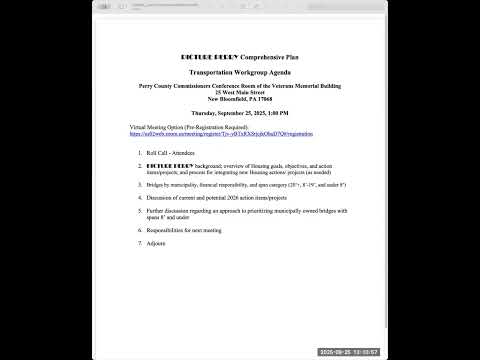
Jason Finnerty, county planning coordinator, opened the meeting by urging re-engagement of the county bridge inspector so municipalities could raise site-specific questions and document priorities for the Picture Perry plan amendments. Municipal participants described a gap between the structures PennDOT inspects and the many smaller township culverts that fall to local crews.
An attendee who has been tracking storm damage described concentrated impacts from last year’s storm band, including multiple culvert failures in Rye Township and Marysville and several landslide-related replacements now in design. “I sat here in my office, and that thing is a 15 minute period that it just rolled off the the, the gutters,” the participant said, recounting a 15‑minute observation of intense runoff and later estimating “4 to 6 inch rainfall in about a 4 hour period.” That speaker emphasized frequent post-event maintenance checks and removing sediment before small overtoppings become full failures.
Rick Knapp, mayor of Duncannon, encouraged municipal road foremen to use PennDOT’s Local Technical Assistance Program (LTAP) training and pointed to a municipal class on bridge and culvert inspections. Knapp said the LTAP course covers inspection basics, prioritization and potential funding sources.
Speakers described practical repair and prevention measures: pumping and removing accumulated sediment from box culverts, installing heavier riprap or geogrid/cellular confinement systems to stabilize embankments, and using local rock sources where available. Officials noted PennDOT’s inspection regimen typically covers bridges at or above the state’s span threshold while many sub‑20‑foot structures depend on township crews for routine maintenance.
Officials also raised nontechnical process issues: the need for a county policy to define when local crews should call engineers post‑event, how to avoid large engineering bills by triaging calls, and the importance of documenting problem sites in the Picture Perry amendment cycle so projects can be considered for regional TIP programming.
The meeting closed with staff promising to assemble a summary report and municipalities agreeing to pursue targeted training and maintenance plans. Finnerty said the work group will reconvene in January to review compiled priorities and any follow‑up technical recommendations.