
Prescott officials review license-plate reader program amid privacy and retention questions
Get AI-powered insights, summaries, and transcripts
Subscribe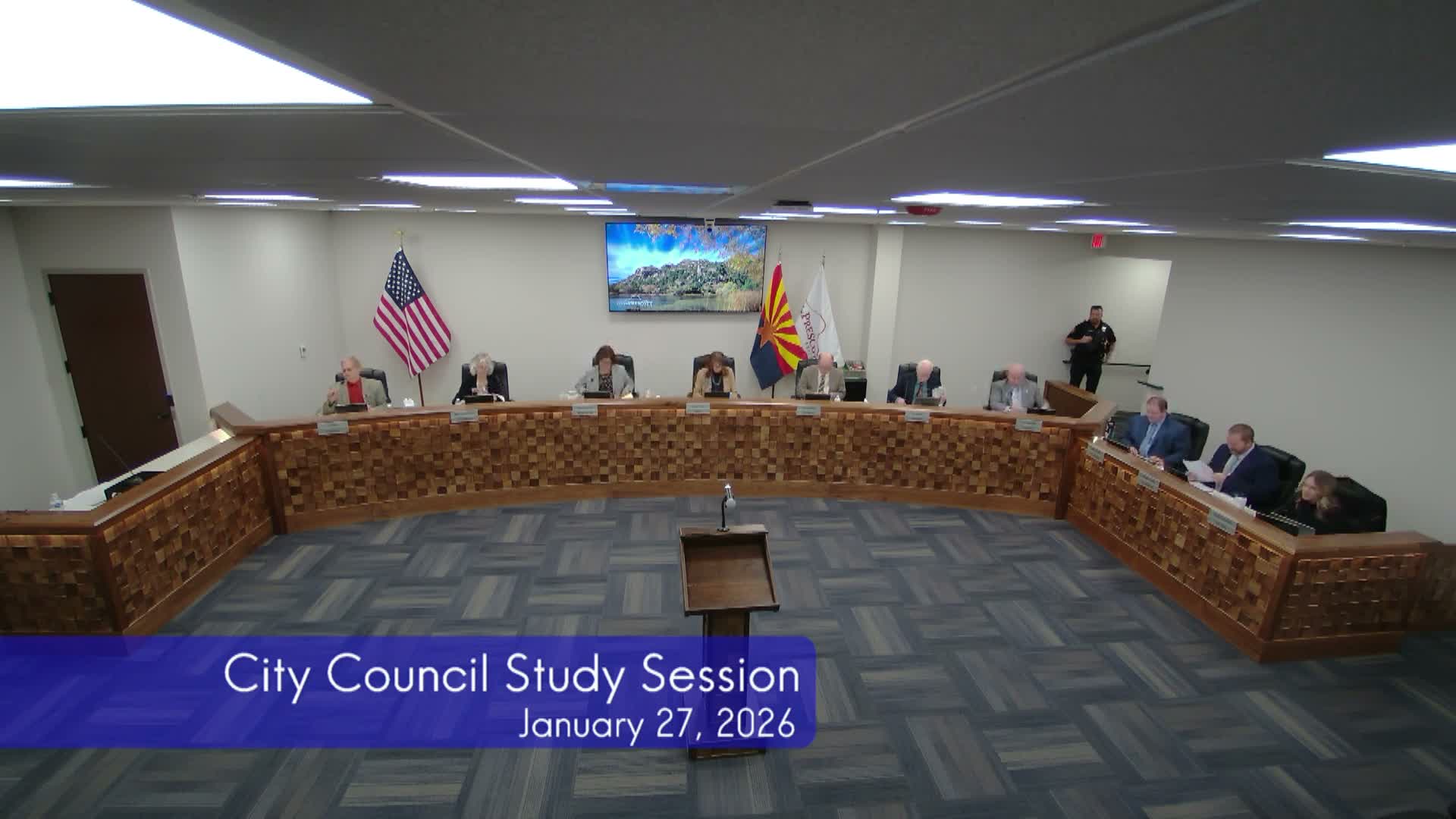
Summary
City police and vendor Flock presented how automated license-plate readers (ALPRs) are used in Prescott, citing crime-solving gains and a 30-day retention standard; council pressed on privacy, sharing limits and pending state legislation (SB1138).
Prescott officials spent much of a Jan. 27 study session reviewing how the city's automated license-plate readers are used and governed, with police and vendor representatives emphasizing investigative benefits while answering council questions about privacy, data retention and who can access the system.
The city's police chief described the technology as vehicle-focused and investigative: "What they do not do, they do not perform facial recognition," the chief said, adding that ALPR systems capture images of license plates in public view and "do not identify or track individuals." The chief said Prescott uses multiple vendors, including Axon, Vigilant (Motorola) and Flock, and that searches are logged, audited monthly and restricted to trained, authorized personnel.
Legal counsel told the council that courts have generally held people traveling on public thoroughfares have no reasonable expectation of privacy and that collecting license-plate information in public "is not protected by the amendment." Trevor Chandler, director of public affairs for Flock, told the council the company does not sell or independently share agency data: "Flock does not sell data, period," he said, and added that agency owners decide whether and with whom to share images.
Police provided local impact figures to illustrate use of the system: the department credited ALPRs with assisting in cases that led to 353 offenses charged in 2024 and 874 offenses charged in 2025, and said regional partners used nearly 8,900 searches in 2025 for calls that included missing persons, hit-and-runs and felony flights. The chief also said the city enforces a 30-day retention policy for non-evidentiary images in its Flock and Axon systems; images tied to criminal investigations are moved to the evidence system and retained as required for prosecution.
Council members pressed several policy points. Some asked about demonstrations and social-media claims that cameras were "hackable"; Flock said a small number of cameras had a temporarily unencrypted configuration during testing and that issues were fixed. Others raised the pending state bill SB1138, which was described during the session as initially drafted with a 90-day retention allowance; city staff said the bill was being rewritten and that Prescott's current practice is more restrictive than the bill's early draft.
The study session produced no vote; staff and the vendor said they would return with further details if the council requested them. Mayor Roosing closed the ALPR portion by thanking presenters and noting the session was informational only.