
Burbank studies prepaid clean‑energy bond that could cut PPA costs by about $1.3 million a year
Get AI-powered insights, summaries, and transcripts
Subscribe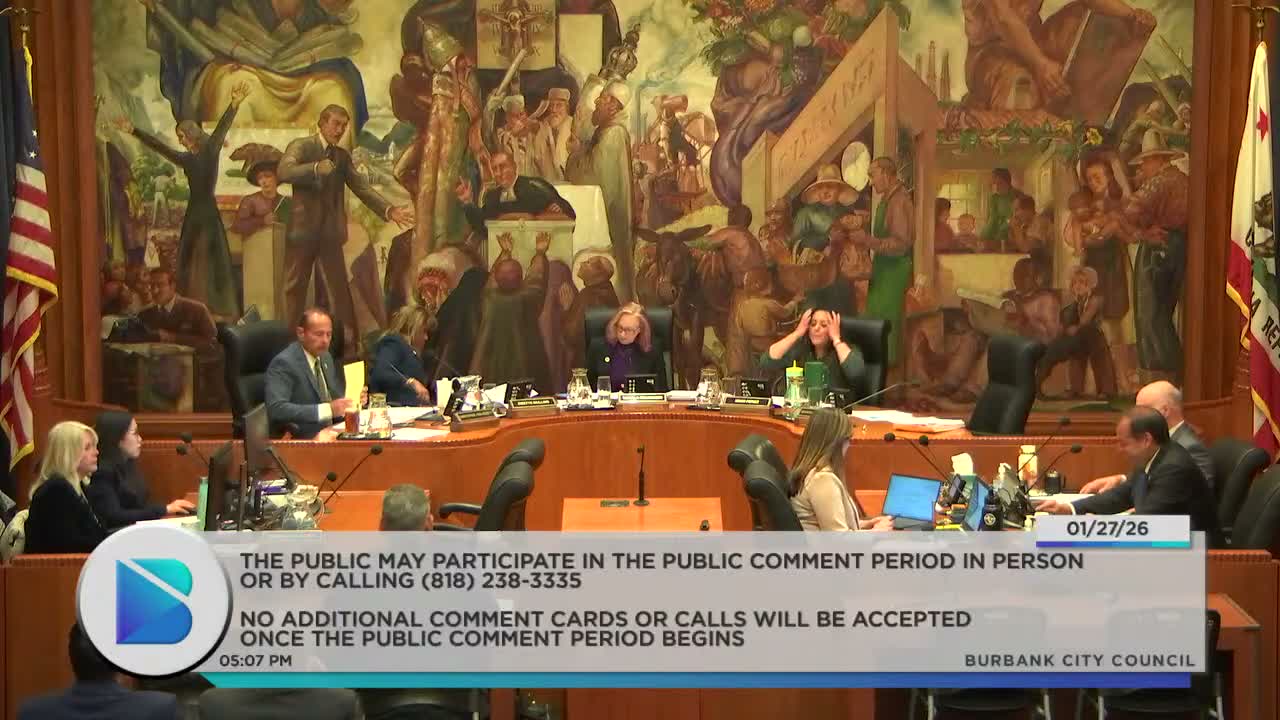
Summary
At a Jan. 27 study session the Burbank City Council reviewed a SCAPA-run prepaid clean‑energy bond that would prepay four existing power purchase agreements; staff said the structure could save roughly $1.3 million annually but a cost‑of‑service study is needed to quantify customer rate impacts. No council vote was taken.
Burbank officials on Jan. 27 reviewed a proposal to join other Southern California utilities in a prepaid clean‑energy bond through the Southern California Public Power Authority that staff said could lower costs on existing power purchase agreements (PPAs) by roughly $1.3 million a year.
Joe Luleo, chief financial officer for Burbank Water and Power, told the council the city would assign limited energy rights from four current PPAs—Desert Harvest 2 Solar, Copper Mountain Solar, Wild Rose Geothermal and Thule Hydro—into a pooled SCAPA bond transaction so the utility could repurchase the same energy at discounted rates. "We will be saving about $1,300,000 per year on our PPA contracts," Luleo said, calling the savings an estimate based on current market conditions.
PFM Financial Advisors' Michael Burwanger, SCAPA's municipal advisor, described how the structure works: SCAPA would issue nonrecourse tax‑exempt bonds on behalf of participating utilities, and Burbank would not be the issuer or directly pledged to bondholders. "Your pledge is not to the bond holders directly," Burwanger said, adding that "if you receive power, you pay for the power. If you don't receive power, you make no payments." He cautioned that savings depend on bond pricing and that the city would lose the savings if the transaction later terminated.
Staff framed the proposal as a low‑risk way to reduce costs on contracts the city already pays for. Luleo cited a SCAPA precedent: a 2024 prepaid transaction involving Anaheim Public Utilities that staff said generated about $3.5 million in annual savings. He also noted Burbank previously used a prepaid structure for natural gas in 2007 that staff estimate has saved about $800,000 per year since issuance.
Council members pressed for clarifications. Vice Mayor Mullins asked whether the city would take on additional obligations; staff reiterated that SCAPA issues the bonds and the city's contractual obligations under the PPAs remain unchanged. A council member asked whether renewable energy credits (RECs) would be affected; staff said REC assignment would not change and reiterated the city's renewable targets, noting Burbank's goal of 100% by 2040 and the state RPS goal cited at 100% by 2045.
Council member Rosati asked how the projected savings would translate to customer rates. Staff said the city has two scheduled rate adjustments (effective Jan. 1, 2026 and Jan. 1, 2027) and that the prepaid savings could reduce future adjustments but that a formal cost‑of‑service study would be required to calculate a specific rate impact.
The study session produced no formal council action; staff said the Burbank Water and Power Board unanimously supported pursuing the opportunity on Jan. 8. The council recessed for a half‑hour before its regular meeting at 6 p.m. and did not vote on the proposal during the study session.