
Burbank council orders legislative push and environmental review as SB 79 looms
Get AI-powered insights, summaries, and transcripts
Subscribe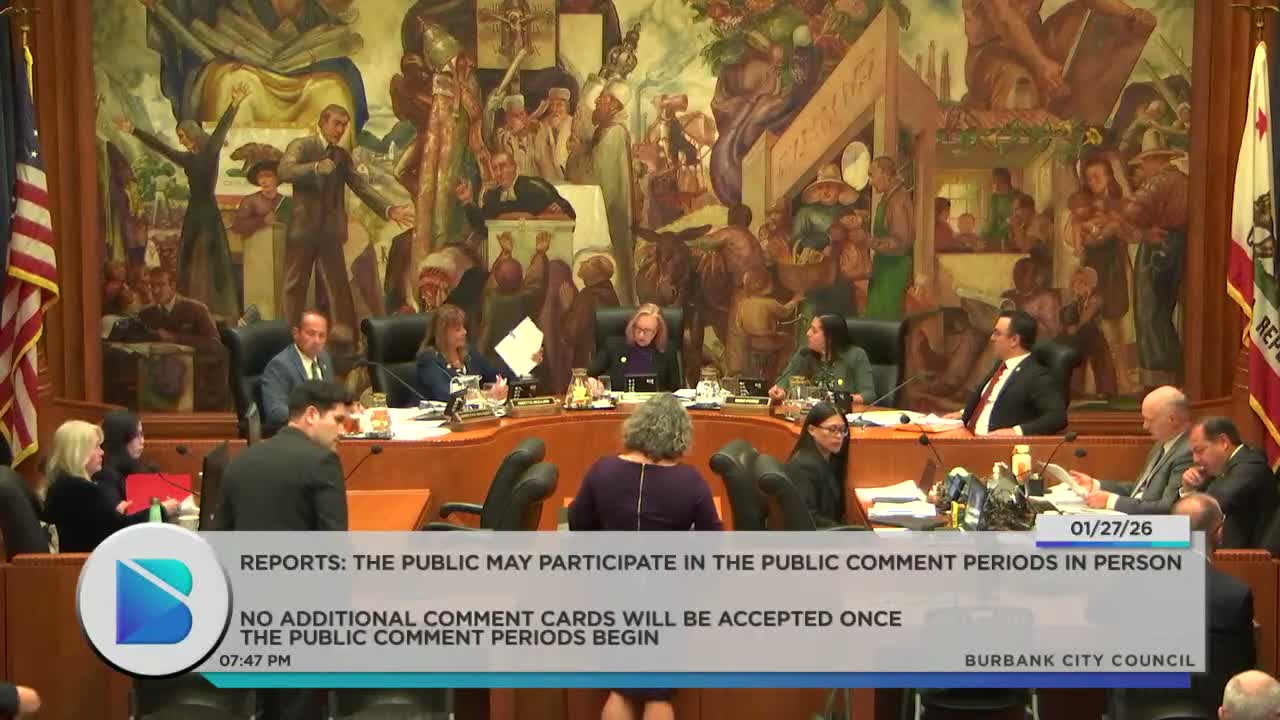
Summary
After a staff briefing on state law SB 79, the Burbank City Council directed staff to pursue legislative fixes, press SCAG and Metro for map clarifications, request subsequent environmental review from Metro for dedicated-lane designs, and continue local specific plans to protect infrastructure and neighborhood character.
The Burbank City Council on Tuesday moved to push back against parts of California’s new SB 79, directing staff to pursue cleanup language with state legislators, press regional agencies for clarity on which bus-rapid-transit stops qualify under the law, and seek additional environmental review tied to dedicated-lane BRT designs.
Staff presented a detailed analysis showing that SB 79 creates two tiers of transit-oriented development (TOD) stops and prescribes minimum densities and heights for qualifying sites. Principal planner Amanda Landry told the council that, under the city’s reading of the statute, three Tier 2 locations in Burbank are most likely to qualify — the Downtown Metrolink station and two Glen Oaks/Alameda-area stops — but that the law’s definitions are ambiguous for bus rapid transit (BRT) projects because the statute ties “stop” status to full-time dedicated lanes.
“Just because something is called a BRT doesn’t mean it automatically qualifies,” Landry said, noting staff’s analysis of underlying qualifying criteria and map overlays, including exclusions for very high fire hazard severity zones. She explained that roughly 3,000 parcels lie within a half-mile of the identified stops and that fewer than 300 parcels within those zones are currently zoned exclusively single-family. Staff warned that housing built under SB 79 or similar state-streamlined processes could trigger prevailing wage and other state workforce requirements that raise development costs.
City Attorney and planning staff urged caution on permitting decisions tied to the Metro BRT design, saying that physical construction or rights-of-way decisions that establish dedicated lanes could alter whether SB 79 density circles are drawn, and therefore whether state density and height rules apply. The city attorney also said the final environmental impact report adopted for Metro’s BRT did not contemplate SB 79 densities and that state law changes since the EIR may trigger subsequent environmental review if there is new information or changed circumstances.
Council debate centered on strategy. Vice Mayor Mullins and others pressed for “very firm” letters to state legislators and the governor, an extension of the SB 79 effective date, and clear accounting of the infrastructure costs — including sewer, water reclamation and electrical upgrades — that would accompany any surge in development. Staff cited preliminary estimates ranging from tens to hundreds of millions of dollars for wastewater treatment and conveyance upgrades tied to the city’s broader housing planning (specific-plan) alternatives.
Councilmembers divided on one item. In a separate roll-call vote, the council approved a motion directing staff to pursue cleanup language via the legislative process. Councilmember Anthony voted no on that first motion; other participating members voted yes, and one member had recused from the report earlier in the meeting. The council then passed a second motion, by majority vote, that directed staff to (1) continue discussions with SCAG on official SB 79 eligibility maps and with Metro on potential BRT impacts, (2) request that Metro prepare subsequent environmental review for any dedicated-lane designs that would change the previously analyzed project scope, (3) revise and streamline local housing development processes to provide timely local review and incentives that make local approvals more attractive than state options, and (4) continue local specific-plan work so the city can offer its own objective development standards.
Landry and other staff emphasized the uncertainty: cleanup bills (including SB 677/609 and SB 908 at the time of the meeting) were in play and SCAG must publish a final map that could change the city’s exposure. Staff recommended monitoring legislative changes while pursuing clarifying amendments to the statute that narrow applicability, exempt cities with certified housing elements, or better define which BRT configurations — not paint-on-street, mixed-flow service versus full-time dedicated lanes — trigger SB 79’s automatic densities.
Next steps: staff will coordinate with the city’s state advocacy firm and the City Manager’s office to draft language for outreach to state representatives, provide regular council updates, continue talks with Metro and SCAG, request subsequent environmental review where project designs suggest a change in impacts, and bring forward revised specific-plan materials intended to offer local, objective standards to guide future projects.