Cottonwood Heights reviews draft general plan: council prioritizes economic identity, transportation and housing
Loading...
Summary
Planning staff and consultants discussed a working draft of Cottonwood Heights' general plan, recommending public engagement after the council confirms high-level goals. Topics highlighted included Olympic readiness, transportation master-plan alignment, redevelopment of the gravel pit, lodging and housing options including ADUs.
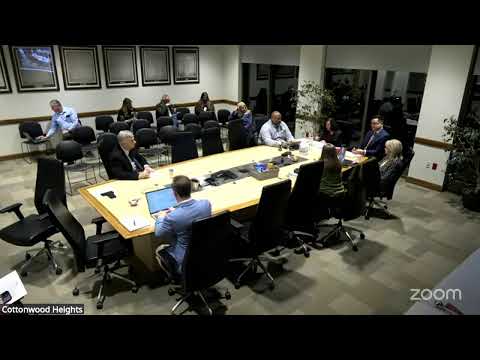
The Cottonwood Heights City Council spent the bulk of its Jan. 20 work session reviewing a working draft of the city's general plan, focusing on economic development, transportation, land-use mapping and housing policies.
Planning staff led by Jim Spung and consultant Sam Taylor described the next steps: finalize high-level goals and objectives, then broaden public engagement through online tools and in-person open houses. "Once we solidify the goals and objectives, we can then engage the public," Spung said, asking the council to give clear direction so consultants can refine the draft.
Context and budget: Council members asked about a WFRC grant that funded earlier plan work; Christie Dahlberg (joining virtually) said some funding remains but several invoices are on hold and that the available balance is "a little under $15,000" pending reconciliation. Staff said the $170,000 grant was used to develop baseline materials and that remaining work and contract scope will determine whether that balance is sufficient.
Economic development and Olympic readiness: Council members debated whether to explicitly reference the 2034 Utah Olympics in the plan. Supporters said including Olympic-readiness language could help staff pursue funding and prepare for visitor demand, while others cautioned against treating the Olympics as a panacea for long-term strategy. Members favored signaling an economic identity for the city's three key nodes — town center, Canyon Center and the gravel-pit area — and using the future land-use map to guide zoning and redevelopment.
Transportation and multimodal access: The council discussed aligning the general plan with the 2023 Transportation Master Plan and suggested appending detailed transportation projects or referencing them to avoid duplicating project-level budgets. Ideas under consideration included microtransit, improved multimodal connections to canyon trailheads, and using shared parking and transit strategies to support redevelopment.
Housing and aging in place: Members urged the plan to better acknowledge an aging population and to include policies supporting diverse housing choices — ADUs, townhomes and workforce housing — to enable multigenerational living and turnover without neighborhood blight. Staff said policy language in the general plan would drive future zoning updates to implement those priorities.
Next steps: Council asked staff to refine the draft, prepare a public-engagement scope and a calendar for outreach, and return with a clearer scoping and budget recommendation for consultant work. The joint session ended with staff promising a public-engagement plan and more granular follow-up on chapters that need refinement.