Get Full Government Meeting Transcripts, Videos, & Alerts Forever!
Get email alerts on the Budget topic
No spam. Unsubscribe anytime.
Niagara Falls board previews rough draft of 2026–27 budget, flags $7.6M gap and reserve use
Summary
At a Jan. 22 public meeting the Niagara Falls City School District reviewed a preliminary 2026–27 budget draft showing a projected $7.6 million gap; officials outlined possible responses — use $2.0–2.5M of reserves, modest levy increases, spending cuts or finding new revenue — and flagged a $2.2M UPK aid increase and need for four special-education classrooms.
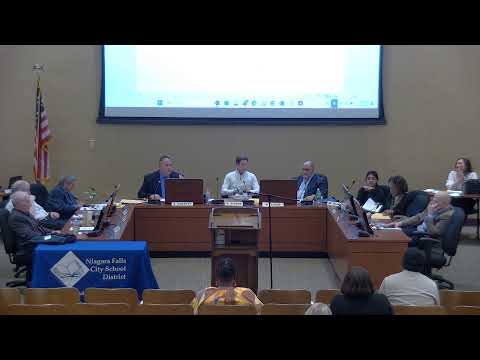
The Niagara Falls City School District board on Jan. 22 reviewed a preliminary draft of the 2026–27 budget and was warned the district faces a projected $7.6 million shortfall if the draft’s full set of revenue and expense assumptions hold.
Superintendent Mark Lohrey presented the draft as a first pass and said the district expects to use between $2 million and $2.5 million of its $4.83 million reserve carryover this year, pending further verification by finance staff. ‘‘This is a very, very rough draft based on estimates,’’ he said, and finance staff will roll salaries forward name-by-name before the board’s next meeting.
The presentation listed projected revenue adjustments of roughly $4.5 million and a preliminary total projected revenue of $202,572,287. Officials said the district did not receive a $570,000 foundation-aid true-up it had expected, and that the initial SERS-based foundation-aid estimate showed an increase of about $5.3 million — figures that will be certified again on Feb. 15 and May 15.
Among the most significant single changes in the governor’s proposal was a large increase in universal prekindergarten (UPK) funding. Finance staff said the UPK change could produce approximately $2.2 million in additional aid for Niagara Falls; the board said it will audit student-level support to ensure the district documents allowable uses for that grant money.
On the expense side, board members noted an estimated $3 million in personnel cost increases reflected in the draft and warned that several grants have expired or are phasing down, requiring the district to move roughly $478,000 in positions into the general fund if programming continues. District staff also said they currently anticipate adding at least four special-education classrooms next year, a change that would require multiple aides per new class and add materially to personnel costs.
Officials listed options to close the gap: find new revenues, enact program reductions (including through attrition), and use reserve funds. The board said raising the tax levy 1% would yield about $258,000; a 2.1% levy would add roughly $541,000. ‘‘It is far too early to recommend any of those strategies,’’ the superintendent said, but he asked the board to consider the full set of choices.
Other cost pressures flagged included rising utilities, a survey of health-insurance projections (the draft uses a 10% increase for active staff and 15% for retirees), and BOCES and charter tuition increases. District staff said they are using conservative assumptions for TRS and ERS employer rates and will revisit figures as state guidance updates.
What happens next: finance staff will complete the detailed salary roll-forward and update revenue and expenditure lines before the board’s Feb. 12 meeting; the board will return to the budget in subsequent meetings as part of a multi-session review.
Budget provenance: The budget preview and numbers were presented and discussed during the Jan. 22 meeting (presentation and Q&A recorded in the meeting transcript).