Get Full Government Meeting Transcripts, Videos, & Alerts Forever!
Get email alerts on the Historic Preservation topic
No spam. Unsubscribe anytime.
Public hearing draws residents and preservationists after demolition request for Cottonwood Heights Old Mill
Summary
The planning commission opened a public hearing on a request to demolish the historic Old Mill at 6851 S. Big Cottonwood Canyon Road (CUP-25-005). Staff recommended continuing the item—the city must wait one year before final action—and the commission voted to continue the matter to March 4, 2026 while staff and the applicant gather additional information.
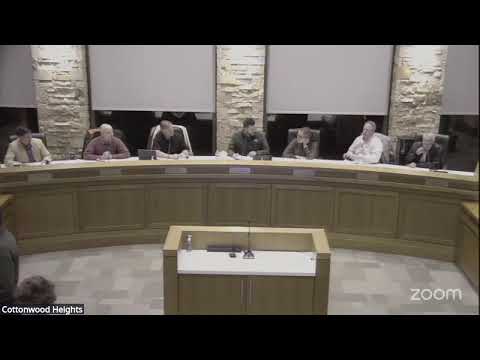
The Cottonwood Heights Planning Commission opened a public hearing on Jan. 21 for Project CUP-25-005, an application by property owner Doug Shelby seeking a conditional-use permit to demolish the historic Cottonwood Paper Mill (the Old Mill) at 6851 South Big Cottonwood Canyon Road.
Staff told the commission that two separate approvals are required before demolition: the planning commission’s conditional-use review and a certificate of appropriateness issued by the city council. Per city code, a one-year waiting period is triggered by the filing of this application; the earliest the planning commission may take a final action on the CUP is Jan. 21, 2027. Staff recommended continuing the item so the commission and community can review submitted engineering studies, request additional documentation (seismic analyses, condemnation history, maintenance records), and consider an independent third-party assessment.
Dan Hammer, counsel for the applicant, said the family has owned the property for generations, considers the structure a public-safety nuisance and believes preservation costs are prohibitive—materials provided with the application include engineering reports and assessments (the applicant’s materials referenced a $100,000,000 figure for full restoration). Hammer also said the owner is willing to partner with the city on preserving select historic elements, a plaque and digital documentation.
The public hearing drew many residents, the Cottonwood Heights Historic Committee, Preservation Utah, 7 Canyons Trust and contractors experienced in masonry restoration. Speakers urged preservation, asked the city to enforce protective-maintenance ordinances, offered fundraising or pro-bono technical help, and highlighted concerns about demolition-by-neglect, creek impacts, traffic and wildfire evacuation if high-density redevelopment follows demolition. The Cottonwood Heights Historic Committee recommended prioritizing preservation, rejecting expedited demolition, enforcing existing ordinances, and—if demolition proves unavoidable—comprehensively documenting the building and establishing a public memorial.
Commissioners and staff compiled a list of follow-up requests for the record: historic-designation implications, additional seismic data, the property’s condemnation history and supporting documents, enforcement history under protective-maintenance code (Cottonwood Heights code section referencing protective maintenance and a 120-day owner-remedy period), a more exhaustive building history and due-diligence records, and clarification on who prepared previous studies. Commissioners discussed whether the city should fund an independent structural review and agreed to continue the item to give time for documentation and community input. A motion to continue the matter to the March 4, 2026 meeting carried.
Next procedural steps: the planning commission will use the year-long review period to gather requested documents and technical analyses; a final decision on the conditional-use demolition permit cannot occur until at least Jan. 21, 2027. Separately, the city council must review and approve a certificate of appropriateness for demolition under the city’s historic-preservation rules before a building permit could issue.