
Green Mountain Power tells House committee it's 79% renewable, outlines storage, resiliency work and 7.5% rate filing
Get AI-powered insights, summaries, and transcripts
Subscribe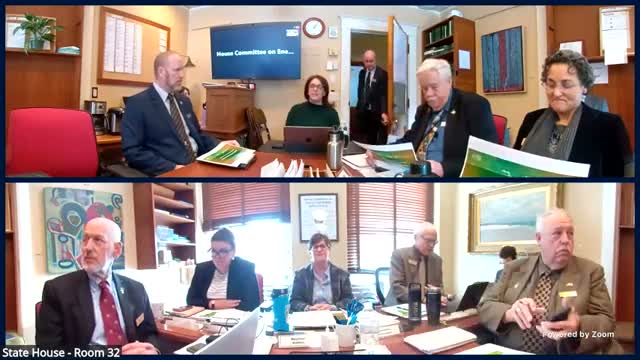
Summary
Green Mountain Power told the House Energy and Digital Infrastructure Committee on Jan. 28 that its 2024 portfolio was 79% renewable and 100% carbon-free when including nuclear, described a 75 MW aggregated battery fleet and extensive storm-hardening, and said it has filed a 7.5% rate case to take effect Oct. 1.
Green Mountain Power briefed the House Energy and Digital Infrastructure Committee on Jan. 28 about the utility's customer base, resource mix, grid-storage projects, resiliency investments and an upcoming multi-year rate review.
Candice Morgan, a Green Mountain Power representative, said the utility serves roughly 275,000 customers across Vermont (about 77% of the state's customers) and employs about 500 people. Morgan said GMP is a certified B Corp since 2014, a governance status she said codifies obligations to community, employees and the environment.
On generation, Morgan told the committee GMP's post-REC 2024 portfolio was roughly 79% renewable and 100% carbon-free when including long-term nuclear contracts. She described the Renewable Energy Standard (RES) tiers and said the new Tier 4 (large regional renewables) may require earlier review than previously scheduled given federal and regional market shifts.
Morgan described GMP's energy-storage and virtual power plant work: more than 8,000 residential battery systems plus larger grid-scale storage that together provide about 75 megawatts of dispatchable capacity. She said aggregated storage helped reduce regional procurement costs by roughly $3 million during a June 2025 peak event and that such resources can reduce customer bills by avoiding purchases of expensive peak power.
On resiliency, Morgan described spacer-cable overhead reconductoring, selective undergrounding in high-risk rural circuits and rights-of-way relocations. GMP reported completing about 70 miles of undergrounding and just over 40 miles of overhead storm hardening in the prior 18 months and said those efforts produced an approximately 95% reduction in customer-hours-out on the hardened circuits during severe events. She credited a legislative Act 250 exemption (through 2030) with enabling faster repairs and relocations.
Morgan also described customer-facing programs: an ARPA-funded energy-storage assistance pilot that has placed 23 backup systems for income-eligible customers and an energy assistance tariff that provides a 25% discount for customers at or below 185% of the federal poverty level, with updated arrearage-forgiveness provisions.
On finances, Morgan said GMP filed a full rate case in mid-January seeking a 7.5% increase, a contested proceeding that will run about nine months, with a decision by the Public Utility Commission anticipated in September and new rates to take effect Oct. 1. She identified rising power-supply and regional transmission costs, inflation on materials and contracts, property taxes and health-care costs as the principal drivers.
Committee members pressed GMP on several points: the composition and expiration timing of GMP's large hydro and nuclear contracts (Morgan said many nuclear contracts, including joint ownership arrangements, extend into the mid-2030s); whether a switch from the RES to a Clean Energy Standard would increase procurement costs (Morgan said estimates suggest multi-million-dollar annual impacts in the 2030s, and GMP's power-supply team has offered a $4 million annual estimate in potential savings associated with current nuclear arrangements); and how to quantify the 'cost shift' sometimes attributed to net metering customers. Morgan acknowledged there is not yet a single accepted methodology across stakeholders and said GMP would follow up with more detailed analyses.
Morgan emphasized safety and operations: GMP has not experienced battery-fire incidents in its Vermont fleet; installations vary by location (basement, garage, or exterior). She said the company is continuing work on non-transmission alternatives that combine load controls, managed EV charging and storage to reduce reliance on more expensive transmission upgrades.
The committee thanked Morgan for the update and asked for follow-up materials on storage take-up, the firming value of different generation contracts, and more detail on the net-metering cost-shift calculations. The session then shifted to consideration of H.710, a bill to amend the statutory definition of an electricity-generating "plant" for renewable programs.