Monroe County leaders say current jail fails constitutional standards; debate sites, design and financing ahead of ACLU timeline
Loading...
Summary
County commissioners and councilors agreed the existing jail does not meet constitutional care standards and cannot be practically renovated. The group debated single‑floor versus multistory designs, site options including North Park and Fullerton, financing limits and next steps including a joint meeting with the sheriff and board of judges.
Monroe County commissioners and county council members acknowledged on Jan. 22 that the county’s existing jail does not meet constitutional care and safety standards and agreed the current building is not a viable candidate for renovation.
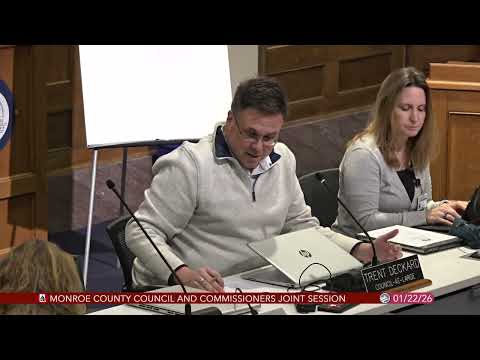
The joint work session — convened by county commissioners and the county council — centered on five questions carried over from prior meetings and a letter from an ACLU representative. Councilors and commissioners repeatedly told one another they do not believe the jail, as configured today, can provide the space and facilities required by constitutional standards. Several participants referenced a facility tour and correspondence from the Indiana ACLU documenting outstanding concerns.
Why it matters: The answers will shape whether Monroe County must build a new jail, where it will be located, how it will be designed and how much taxpayers may be expected to pay. Officials said they face competing constraints: an ongoing lawsuit and a requested 90‑day period for demonstrable progress, tight county financing capacity and zoning and site constraints in city and county properties.
What was decided and discussed: Elected officials from both bodies concluded that the jail’s current footprint and structural design make renovation impractical. One county official summarized engineering and operational limits as “you cannot make it bigger than it is,” and multiple attendees agreed that converting or adding an elevator shaft and other retrofits would not resolve core circulation and space deficits.
The group debated single‑floor versus multi‑story options, co‑location of courts and jail functions and alternatives such as diversion and work‑release programs that could reduce bed needs. Participants also discussed potential sites that have been studied previously, including North Park, Fullerton, Thompson and Vernal. Councilors clarified that a prior purchase agreement for a North Park parcel had been voted down in October and described that document as expired; nonetheless, officials said they are exploring multiple properties while noting zoning overlays and time required for planning approvals.
On cost and financing, presenters reminded members of previous long‑term finance work that identified three broad paths: a voter referendum, waiting for state legislative adjustments to local taxing or bonding authority, or using existing bonding capacity. An August estimate shared in past meetings suggested the county could issue roughly $19.3 million in bonds under then‑current assumptions, but officials cautioned those figures may have changed.
Sheriff Marte, who attended the session, told the group he was uncertain Monroe County could meet a 90‑day benchmark given operational constraints. "I don't know if you're gonna make this 90 days based on what I'm hearing right now," he said, adding that classification and staffing challenges limit immediate options.
Next steps: Officials agreed to gather specific, data‑driven benchmarks and to increase joint communications. Suggested near‑term deliverables included daily population reports, incident summaries, recreation and programming descriptions, staffing tallies and a schedule of meetings with the sheriff and the board of judges. Legal staff will advise whether property discussions require executive session. The bodies also discussed producing a public timeline or priority list of tasks that can demonstrate “clear movement” to outside stakeholders.
No formal votes or final decisions on a site, budget or design were taken during the work session. The session concluded with a plan to convene follow‑up meetings and to share regular written updates where possible.