
Vermont transportation officials outline plan to start mileage-based fee for electric vehicles, aim for 2027 launch
Get AI-powered insights, summaries, and transcripts
Subscribe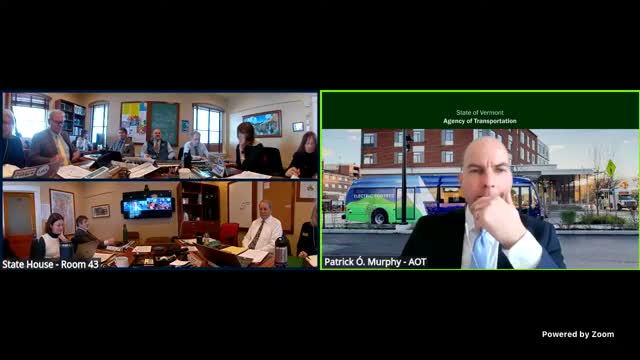
Summary
Agency of Transportation officials told the House Transportation Committee they will seek statutory language to implement a mileage-based user fee for battery-electric vehicles, leveraging an 80/20 federal-state implementation grant and existing DMV inspection systems; rate-setting work from UVM will guide design.
Patrick Murphy, state policy director for the Vermont Agency of Transportation, told the House Transportation Committee on Jan. 20 that the administration will seek statutory language this legislative session to implement a mileage-based user fee (MBUF) for battery-electric vehicles with a targeted start date of Jan. 1, 2027.
The proposal would begin with fully electric passenger vehicles and use odometer readings collected through the annual vehicle safety inspection process to measure miles traveled. Murphy said that approach minimizes privacy concerns that have emerged in other states that use telematics or geofencing, and it lets Vermont leverage recent IT investments in the DMV. Murphy told the committee VTrans and DMV have invested roughly $50,000,000 in core IT systems that will be used to support rate collection and administration.
The administration plans to maximize federal support for the initial implementation. Murphy said an FHWA implementation grant will cover most capital costs and that the Agency has structured a grant-financing plan at an 80% federal, 20% state match. He told the committee a federal grant will cover about $3,000,000 of capital costs toward an approximate $3,750,000 implementation expense; continuing operational expenses will be covered within AOT’s budget.
Murphy said rate-setting is a matter of legislative discretion and described a competitive solicitation that selected the UVM Transportation Research Center to develop a methodology and a report on rate options. That UVM report will include comparisons to other states’ programs and projections of household impacts by geography and demographic groups; Murphy said a draft memo of that work will be shared with committee members within one to two weeks.
Committee members raised equity and administrative concerns. Several members asked why the program would begin with electric vehicles rather than immediately apply to all passenger vehicles; Murphy said language added by the Senate in last year’s transportation bill framed EVs as an interim step toward broader application only if the Legislature later decides to transition other vehicle classes. He acknowledged out-of-state travel is a difficulty under an odometer-based system: the odometer approach measures total miles between inspections and cannot separate in-state from out-of-state driving the way geofencing or telematics can.
Murphy and several members noted administrative trade-offs. He said states that use telematics or third-party vendors have sometimes seen administrative costs consume a much larger share of revenue — testimony cited figures up to 40% — whereas Vermont expects to keep ongoing administrative costs close to typical fuel-tax administration by running the system through state systems and targeting an administrative rate near 3.5% of gross revenue.
On compliance, Murphy emphasized the program would be tied to the vehicle and its registration rather than to the driver, and he said the agency is not proposing license suspension for nonpayment; appeal processes for odometer readings would be built into the administration. To address inspection-frequency changes, Murphy said the Agency can accept mobile-phone odometer photos and pay-as-you-go reconciliation with final accounting at registration renewal.
Murphy said the administration will present statutory language to the Legislature in the coming weeks and return to the committee for additional briefings on rate setting and the statutory framework. The committee did not take any formal votes during the hearing; the hearing will continue to inform legislative drafting this session.