
Reidsville council approves curb‑and‑gutter amendment after recusal and public pushback
Get AI-powered insights, summaries, and transcripts
Subscribe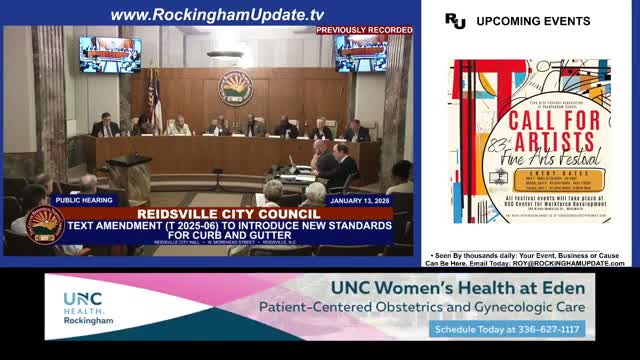
Summary
Council voted to approve text amendment T2025‑07 adjusting curb‑and‑gutter requirements with a tie‑in modification after deliberation, a formal recusal of Councilman Martin and public testimony from developers' counsel that raised legal and maintenance concerns.
The Reidsville City Council on Jan. 13 approved a text amendment (T2025‑07) to the city's subdivision regulations that alters when traditional curb and gutter must be installed for new developments and adds density and watershed exemptions, following a contentious public hearing and a formal recusal.
Drew Bigelow, planning and community development director, summarized staff's proposal: single‑family subdivisions at densities below 6 units per acre would be exempt from curb and gutter while higher‑density subdivisions would remain required to install it; townhome and multifamily thresholds were set at 8 units per acre; developments within the Troublesome Creek watershed could substitute a vegetated ditch and culvert for traditional curb and gutter but would be required to maintain that ditch (or assign maintenance to an HOA), and the technical review committee (TRC) would review sealed engineer stormwater plans to determine whether curb and gutter is necessary. Planning staff also recommended tie‑on requirements to existing infrastructure when exemptions are not met; the planning board had recommended approval by a 4–2 vote but flagged concerns about discretionary authority in the prior draft.
"Staff has been petitioned to review and amend the city of Reedsville's current curb and gutter policy," Bigelow said during his presentation and described the density and watershed exemptions and the TRC review process.
Those provisions drew prompt public comment. Joseph Shuford, an attorney representing several local developers, told council the watershed exemption — which would allow a developer to install a vegetated ditch in the city's right‑of‑way and leave maintenance to the homeowner — improperly shifts a city's maintenance duty to private owners. "The city's ordinance does not do that, and it violates that general requirement, and by requiring the private homeowner or the private property owner to maintain the public infrastructure within the public right of way," Shuford said, asking the council to remove the provision that places that maintenance obligation on private property owners.
Before the council voted on the amendment, members debated whether Councilman Martin should participate given his business interests in local development; Martin said he had sought legal advice and believed he could vote, but other members pressed the recusal question. A motion to recuse Councilman Martin was made, seconded and carried; Martin did not leave the dais but was excused from participation in the matter.
After public comment and council discussion, a motion (mover recorded in the minutes) to approve the proposed text amendment with a modification requiring tie‑in to existing infrastructure even when an exemption is met passed. The council vote was conducted by voice/raised hands during the public meeting and the clerk recorded the outcome; the amendment will be incorporated into the city's subdivision regulations as amended and staff will note the revision for implementation.
What changed: The amendment creates explicit, objective exemptions tied to density and watershed location; it adds TRC review of engineer‑sealed stormwater plans to allow alternative conveyance where appropriate; and the council added a requirement to tie new work into existing curb or storm infrastructure when feasible.
What remains unsettled: Several council members and commenters asked for clearer language on whether the city or private property owners must maintain vegetated ditches placed in the city right‑of‑way and urged staff to ensure that the TRC review process is administratively objective and legally sound. Attorney and staff comments at the hearing included repeated references to North Carolina statutes and to planning‑board procedure; council members asked counsel whether substantial changes required a return to planning board (counsel said it is common practice but not mandatory in every case).
Next steps: Staff will finalize ordinance text and implementation guidance reflecting the council's tie‑in modification and the recusal has been documented in the meeting record.