
Talent board weighs using peer grant to build Gateway Hub versus investing in infrastructure
Get AI-powered insights, summaries, and transcripts
Subscribe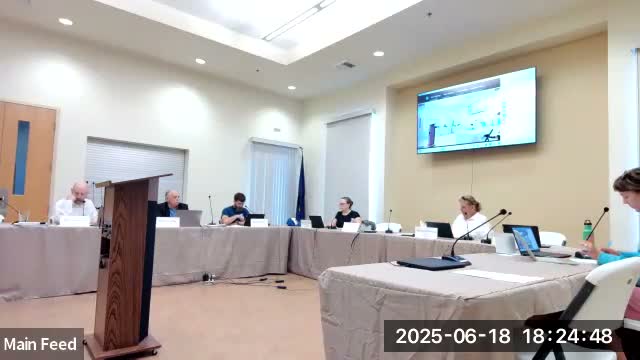
Summary
Board members and staff discussed whether to reallocate parts of a $4.65 million OHCS peer grant toward constructing a Gateway Hub (which would trigger HUD/CDBG performance and LMI job requirements) or to keep funds for infrastructure improvements; the board declared potential conflicts of interest and asked staff to return with more detail by July 2.
The Talent Urban Renewal Agency on June 18 debated whether to pursue construction of a Gateway Hub or to spend peer grant funds on infrastructure that would make the site ready for development.
Staff told the board the original project included a Wagner Street extension estimated at $1.7 million that is likely not proceeding because the Talent Irrigation District declined to sell. Staff said the total peer grant award was $4,650,000 and that Oregon Housing and Community Services (OHCS) is holding $165,000 in contingency; "we have, roughly, $5,000,000 in resources," staff said. Staff estimated project costs of at least about $3.5 million and ballparked $500,000 to $1,000,000 that could be redirected to other project elements.
Staff warned that building a Gateway Hub would likely be characterized as economic development under US Department of Housing and Urban Development rules and that doing so would require additional justification, regional peer‑body concurrence and performance obligations. "They distinguish very clearly between infrastructure that has a ... area benefit, and then building a building, which would really have to be justified as an economic development activity," staff said. Staff also explained a key condition: each occupant or operator would need to meet rules tied to low‑ and moderate‑income (LMI) benefit — roughly 51% of new jobs or participants must serve LMI individuals — and that the wage threshold is indexed to median income.
The board discussed tradeoffs: using funds for infrastructure (parking, walkways, site prep) reduces future capital demands on a developer and avoids triggering additional HUD‑style performance obligations, while directing more money toward a building could accelerate a Gateway Hub but impose repayment or performance risk and a shortened window to raise supplemental capital. Several board members said having a commercial component on the site is a minimum expectation for community benefit.
Both the chair and Vice Chair Parra Miller declared potential conflicts of interest, each stating employment by the Talent Business Alliance and noting the Alliance may present a proposal related to the Gateway Hub. No formal recusal or contract award occurred at the meeting.
Next steps: staff said they could bring additional information by the board's July 2 meeting and, if the board chooses to pursue a building, staff would ask OHCS to reconvene the regional peer committee to consider amending the grant. Several members indicated July 2 would allow enough time for deliberation.
Why it matters: decisions about how to use peer grant funds will affect whether Talent invests in public infrastructure that lowers future private costs or takes on the added complexity and obligations of an economic‑development project that aims to directly incubate microenterprises and small businesses.