Get Full Government Meeting Transcripts, Videos, & Alerts Forever!
Get email alerts on the Public Safety Fire topic
No spam. Unsubscribe anytime.
Stockton officials say Port lacks dedicated firehouses; hydrant failures after warehouse blaze prompt system review
Summary
Fire department leaders told the Stockton City Council that the Port of Stockton lacks staffed firehouses and that two public hydrants and one private hydrant were out of service during a recent recycling-warehouse three-alarm fire. Council asked staff to pursue negotiations with the port and for municipal utilities to bring a funding plan for hydrant repairs.
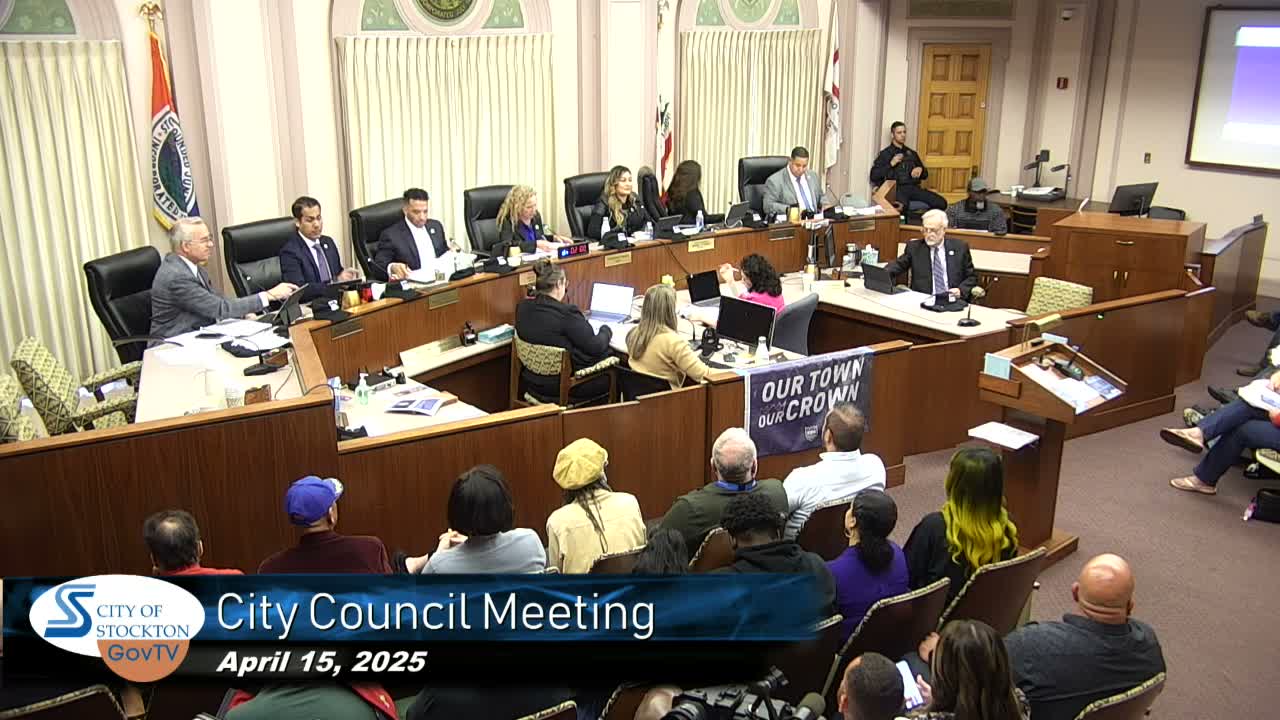
Stockton’s fire chief told the City Council April 15 that the Port of Stockton does not have staffed fire stations and that the city currently provides all on-scene fire protection without a formal service agreement.
"There are not staffed fire houses in the Port Of Stockton," Fire Chief Richard Edwards said. "Today, the city bears 100% of those costs for our firefighters — salaries, apparatus, fuel, maintenance — and risk." He added that the port does pay permit and possessory-interest taxes but the city lacks clarity on how much of that revenue is returned directly to offset fire service costs.
The comment followed a briefing by Deputy Chief Brandon Doolin on a three-alarm recycling-warehouse fire April 2 that exposed vulnerabilities in the water-supply and hydrant system. Doolin said crews initially were delayed after finding multiple hydrants out of service at the scene. "Three minutes after the water attack started, [an engine] called out a hydrant that was out of service," Doolin said. "A minute later ... the second hydrant was called out of service," he said. The department ultimately established relay pumping from functioning hydrants and used mutual-aid water tenders to sustain operations.
Travis Small, director of Municipal Utilities Department (MUD), told the council the city maintains roughly 7,500 public hydrants and about 1,500 private hydrants. MUD's current annual hydrant-maintenance budget is approximately $289,000, which includes about $80,000 for emergency repairs and $90,000 for parts. An earlier third-party audit (Xylem Dewatering) had identified 47 inoperable hydrants; MUD has reduced that number but reported roughly 20–23 inoperable hydrants on any given day due to recurring tampering and aging infrastructure.
"We have to visit those sites twice a week," Small said of problem hydrant locations. He told council staff will prepare a report with estimates for replacements and short-term fixes; rough staff estimates presented in the meeting put needed repairs for about 20 hydrants at an approximate one-time cost of $400,000.
Deputy Chief Doolin also reviewed emergency-notification options and limits. Stockton relies on San Joaquin County Office of Emergency Services to issue Wireless Emergency Alerts (WEAs) and county-managed platforms such as Everbridge; county opt-in registration numbers (about 25,000) limit direct city reach. Doolin recommended the city pursue a multi-tiered communications platform to reach residents directly and to develop criteria for when WEAs would be requested.
Council members and public commenters urged negotiation with the port, improved hydrant monitoring and repair funding, and coordination with state and federal partners for grants or legislative remedies. City Manager Steve Colangelo said staff would ask the assessor’s office for detailed revenue information tied to the port and start laying groundwork for negotiations. The chief recommended a working group including port leadership, fire and finance representatives, and legal counsel to explore cost-sharing, a community facilities district, or similar solutions.
What’s next: MUD will bring a staff report with repair estimates and funding options; fire and MUD will begin weekly coordination and a working group will be proposed to pursue port negotiations and legal analysis.