Get Full Government Meeting Transcripts, Videos, & Alerts Forever!
Get email alerts on the Transportation Traffic Calming topic
No spam. Unsubscribe anytime.
Stockton council allocates $1 million for council priorities, prioritizes neighborhood traffic calming
Summary
Stockton City Council on April 15 authorized $1 million in discretionary funds, directing $850,000 to the Neighborhood Traffic Management Program and $150,000 to the Gospel Center Rescue Mission; council members pressed staff for clearer prioritization metrics and faster outreach to neighborhoods on traffic-calming designs.
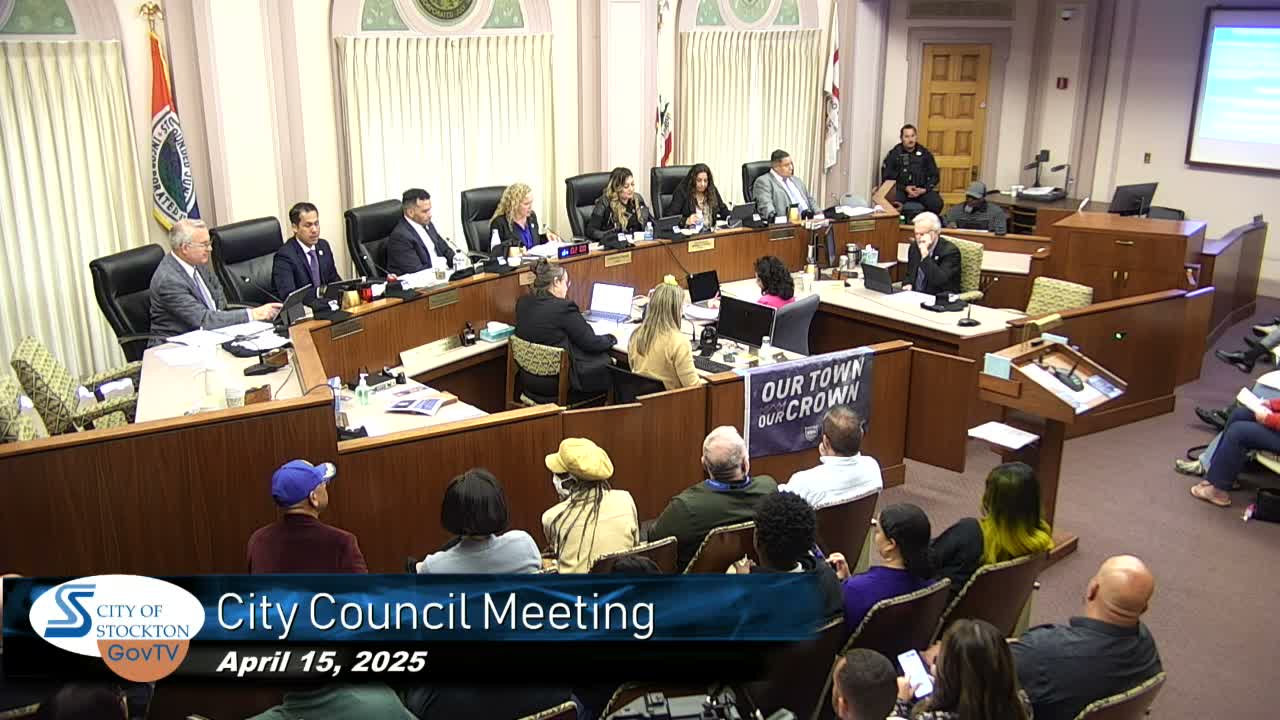
Stockton City Council voted April 15 to appropriate $1,000,000 from fiscal year 2023–24 discretionary funds for council priority projects, directing $850,000 to the Neighborhood Traffic Management Program and $150,000 to Gospel Center Rescue Mission Inc. The motion passed unanimously, 7–0.
The money is intended to accelerate longstanding neighborhood traffic-calming requests and address an identified backlog of candidate locations. "If we were to prioritize this $850,000 in funding, the recommendation would be to defer from our normal first-in, first-out process and prioritize based on the highest accidents per location," Public Works Director Chad Reed told the council, while noting the city’s usual practice relies on the submission date and quadrant rotation.
Council members pressed staff for specifics: how sites are ranked, whether collision counts or application dates govern prioritization, and what treatments neighbors can expect. Reed said the program typically uses community ballots and outreach for each location and that treatments range from inexpensive speed cushions to roundabouts that can exceed $100,000–$200,000. "We solicit feedback from the neighbors," Reed said. "Everybody has to sign on to the agreed-upon approach."
Vice Mayor Lee and other councilmembers argued the city should consider accident rates more heavily when deciding which neighborhoods get earlier treatment. Reed described an operational compromise: maintain quadrant-based staging while pulling higher-collision locations sooner within each quadrant.
Councilmembers also asked about other funding sources. Reed said the department pursues grants but that neighborhood-level traffic calming typically is funded through the city’s CIP and annual budgeting; he said the program historically budgets roughly $1 million per year through the CIP and that discretionary transfers supplement that when available.
The $150,000 to Gospel Center Rescue Mission was described as support for its New Life program and completion of a new program building, intended to expand the nonprofit’s capacity to serve people experiencing homelessness. Council discussion noted the Audit and Budget Committee recommended the allocation.
Council directed staff to proceed with the transfers and to provide greater clarity to council offices and residents on the waiting-list order, outreach schedule, typical costs by treatment type, and the anticipated number of projects the $850,000 will fund.
What’s next: Staff will post project prioritization details and community outreach timelines and bring implementation reports back to council as work orders and contracts are issued.