
Darien Board reviews Fiscal 27 budget; leaders propose self‑insurance and phased switch to propane buses
Get AI-powered insights, summaries, and transcripts
Subscribe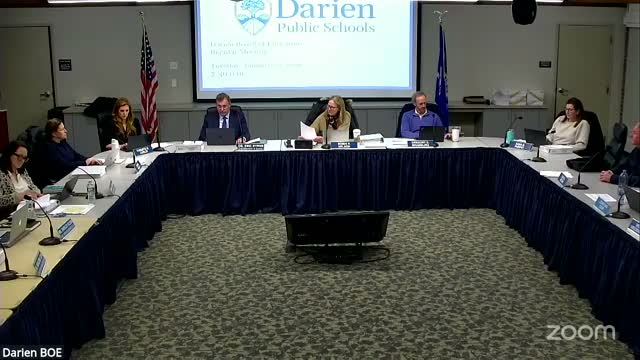
Summary
The Darien Board of Education reviewed the superintendent's Fiscal 27 operations and capital budgets, including a proposal to move medical coverage to a self‑insured model, annual AI tool subscriptions, and a phased transition to propane school buses to meet the Connecticut Clean Air Act; the board set a Feb. 3 public hearing and approved the consent agenda unanimously.
The Darien Board of Education discussed the superintendent's proposed Fiscal 27 operations and capital budgets on Jan. 27, focusing on a recommendation to move district medical coverage to a self‑insured model, technology replacements and subscriptions for classroom AI tools, and a phased transition of the bus fleet to propane to comply with the Connecticut Clean Air Act.
Dr. Byrne introduced the meeting and outlined the budget schedule, including a formal public hearing at 7 p.m. on Feb. 3 and a board vote on the superintendent's proposed budget on Feb. 5. Finance presenter Richard Bridal summarized the operations budget, saying the package includes six areas (facilities, technology, central administration, summer school, fixed costs and safety/security) and amounts to roughly a $1.8 million increase driven largely by technology, a requested public information coordinator, and health insurance increases.
On insurance, Bridal explained the district is proposing to shift from a fully insured medical plan to a self‑insured model in which the district would “hold that risk” and pay claims directly, with a third‑party administrator processing claims. “We are essentially on the hook for the first $250,000 of claims,” Bridal said, describing an individual stop‑loss at $250,000 and aggregate stop‑loss protection set at 20% of expected claims. He added that prescription‑drug rebate payments under self‑insurance would return to the district rather than the insurer — about $600,000 in rebates were cited as a potential benefit in the model.
Bridal said the district will establish an internal services fund to hold reserves for claims variability and that the town treasurer would manage investments on those reserves. He described reporting and monitoring plans: monthly claim reports from Brown & Brown and Anthem and an incurred‑but‑not‑reported (IBNR) year‑end accrual to capture lagged claims.
The board also reviewed technology priorities. Bridal said device replacement cycles are planned (fifth‑grade Chromebooks, fourth‑grade replacements and teacher laptops at the high school), and introduced two subscription AI tools described in the presentation as SchoolAI and Brisk Teaching. Speaker 9 clarified that SchoolAI would be available to teachers and, if adopted for classroom use, to students in grades 3–8. Bridal and others said both platforms will involve annual renewal costs and that broader AI implementation will be considered during the district’s five‑year technology plan.
On student transportation, Bridal said the district has a 7% contractual increase with First Student and must comply with the Connecticut Clean Air Act’s requirement to move to clean energy buses by 2035. “So we are going to propane buses,” Bridal said, outlining a phased plan of roughly five buses a year until all 25 buses are converted; a board member estimated a full 25‑bus propane conversion would cost about $341,000 more compared with diesel. Bridal noted electric buses were not feasible for the district because the depot is rented by the contractor and cannot be retrofitted with chargers.
Bridal summarized capital needs — roughly 60% of the capital plan is for paving projects across district schools, continued school radio replacements and custodial equipment — and estimated capital items discussed at about $1.9 million. He also recommended contracting with Alteris Consulting for district safety and security assessments and an on‑site coordinator, and said that some director‑level security duties would be taken on by that firm if approved.
Board members asked clarifying questions about filling HVAC positions, the composition and reporting line for a potential public information officer (Dr. Byrne said the position would report directly to the superintendent), the mechanics of stop‑loss renewals and reserve handling, and the feasibility of a district bus depot (Bridal said no feasible Darien site was identified; Stamford and Norwalk were explored but purchase costs made a depot unrealistic at this time).
Dr. Byrne also noted four items of feedback from town RTM committees about instructional staffing and clarified there are currently no district literacy coach positions (some roles discussed were literacy intervention teachers), and described how instructional coaches would work with teachers in classrooms to align instruction and support MTSS interventions.
Votes at a glance: The board approved the consent agenda (minutes, the November financial report, proposed budget transfers and committee reports) by unanimous vote. The meeting adjourned after no public comments were made during the budget public comment period.
What’s next: The board will hold a public hearing on the proposed budget at 7 p.m. on Feb. 3; the board is scheduled to vote on the superintendent’s proposed Fiscal 27 budget on Feb. 5.