
Finance commissioner outlines FY27 revenue picture; $104.9M sent to education fund, estate‑tax surplus proposed for school construction
Get AI-powered insights, summaries, and transcripts
Subscribe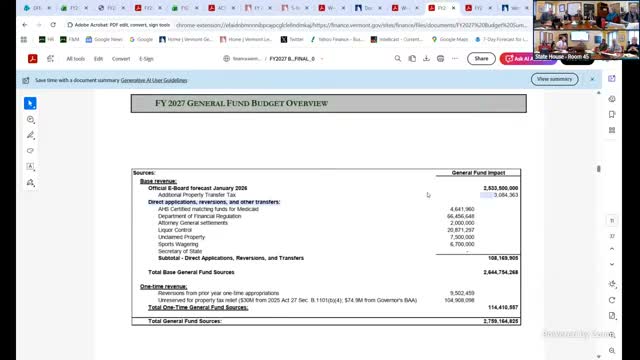
Summary
At a Jan. 28 Ways & Means hearing, Commissioner Adam Gresham said FY27 revenues total roughly $2.533 billion after an $8.5M emergency-board forecast change, and described one-time moves that will send about $104.9M to the Education Fund for property-tax relief and a proposal to redirect excess estate-tax receipts into a new school construction fund.
Adam Gresham, commissioner of finance and management, told the Ways & Means Committee on Jan. 28 that the administration’s FY27 revenue package relies on a top-line eBoard forecast of about $2.533 billion and several one-time moves to bolster the Education Fund.
"At the end of the day, though, I had $2,759,000,000 to deploy in the budget," Gresham said while walking the committee through revenue sources and adjustments. He noted the eBoard downgraded its January forecast by about $8.5 million but that the current top-line forecast remains roughly $130 million higher than last year’s $2.403 billion.
Gresham detailed how the state will assemble one-time resources for property-tax relief: the administration is unreserving a $30 million temporary reserve and carrying forward $74.9 million from the fiscal‑26 budget adjustment (BAA). Together those amounts — about $104.9 million — are being packaged to send to the Education Fund for property‑tax relief. He said the administration also plans to add roughly $10 million tied to purchase‑and‑use tax changes later in the budget language.
On the property‑transfer tax, Gresham explained statutory allocations and a budgetary sweep: roughly half of the transfer tax flows to the Vermont Housing Conservation Board, about a third is already part of the general‑fund forecast, and smaller statutory shares go to municipal and regional planning commissions and to property valuation and review. The administration proposes using approximately $2.5 million toward a housing bond and sweeping roughly $600,000 that the tax department does not need into the general fund.
Rebecca Samaroff of the Tax Department described the Computer Modernization Fund (CMF) transfer. Citing the statutory transfer in "section 3,209 of 32 VSA," she said the FY27 appropriation authority for CMF is $6.397 million while the requested transfer into the fund is about $6.2 million; she told the committee roughly 70% of that appropriation would pay the department’s major contractor, Fast Enterprises, for integrated tax‑system support and upgrades.
Gresham also described a statutory change the administration proposes for excess estate‑tax receipts. Under current practice, estate‑tax dollars above 125% of the eBoard forecast are directed to the Higher Education Endowment Trust Fund. The budget language would instead direct that excess to a newly created School Construction Aid Special Fund. Gresham cautioned those receipts are "lumpy" and not a dependable sole revenue stream: he said last year’s excess was roughly $25–$30 million but that in about half of years the excess has been zero.
Gresham emphasized the limits of those one‑time revenues and the ongoing pressure on base appropriations: he said continuing to run government at current services would require roughly $139 million more next year (possibly $145 million accounting for inflation), underscoring that the state’s revenue picture will remain constrained without structural changes.
Next steps: committee members asked for additional detail and follow‑up testimony from the Tax Department and, where applicable, the Agency of Education and the State Treasurer about the practical effects and timing of transfers, the history of estate‑tax excesses, and the proposed use of endowment funds for capital projects.