
Board hears budget update and equalized-property-value analysis as some taxpayers face large increases
Get AI-powered insights, summaries, and transcripts
Sign Up Free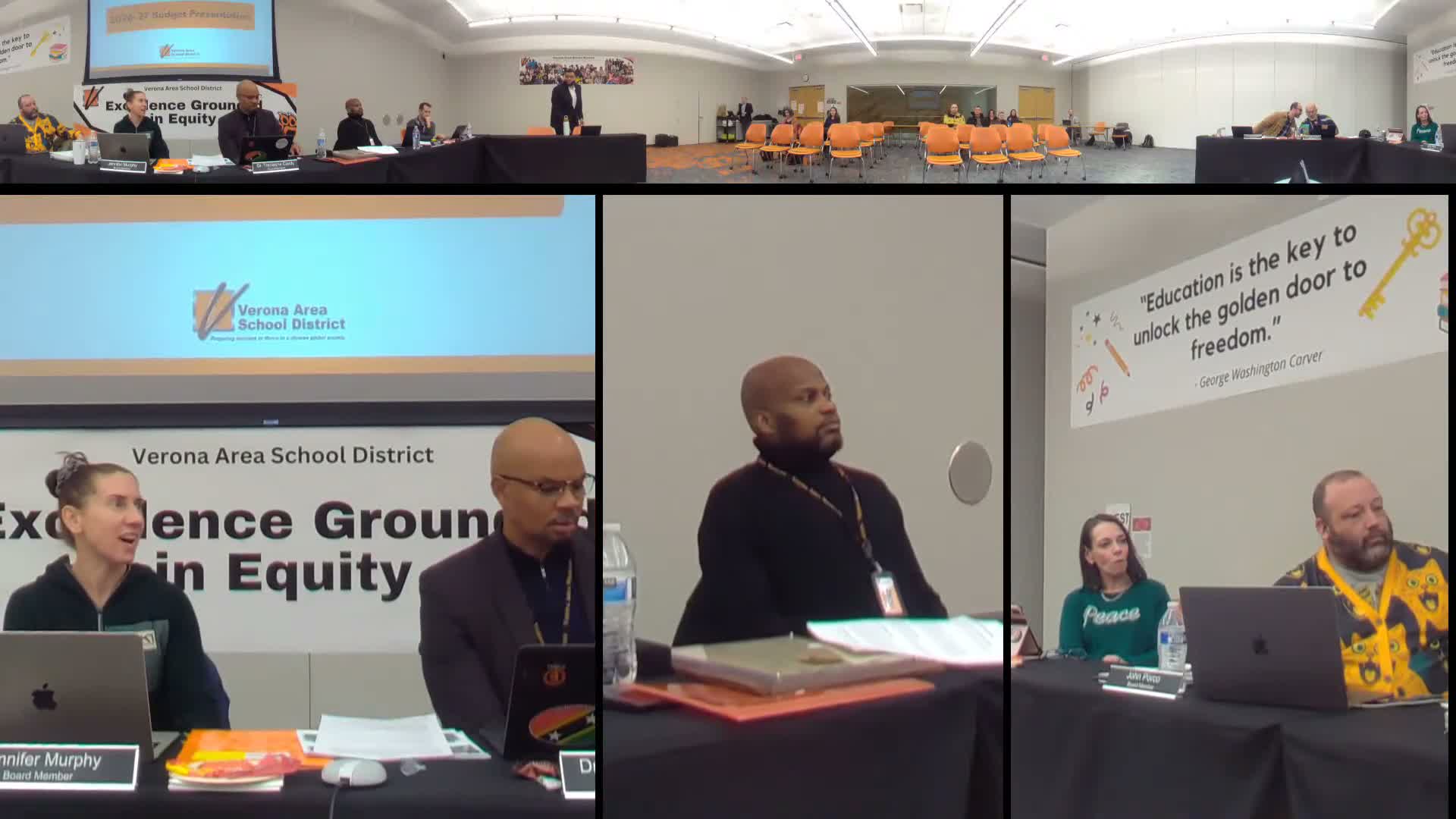
Summary
District finance staff showed a five-year budget model projecting roughly a $2,000,000 gap for 2026–27 under conservative assumptions and demonstrated how Department of Revenue equalized property-value adjustments have shifted school tax burdens—some town taxpayers saw much larger increases than city residents.
District finance staff presented updates to the '26–'27 budget assumptions and a detailed explanation of how Department of Revenue equalized property values affect local tax bills.
Finance staff said they added a line for additional open-enrollment seats and reduced the assumed annual cost-of-living increase from 3% to 2.7%. The presentation relied on the district’s five-year forecast and showed the updated assumptions reduce the projected budget gap but that the district still faces "about a $2,000,000 budget gap" under conservative assumptions.
Staff walked trustees through examples comparing tax bills from residents in the city of Verona and in the town of Verona. They explained Department of Revenue equalization ratios — when a municipality’s assessed values lag market sales, the department applies an equalization factor that raises the fair-market (equalized) value used to calculate the school portion of taxes. The district showed examples in which one city resident’s total bill rose about 7% over three years while a town resident’s bill rose about 24% over the same period because of repeated equalization adjustments.
Board members discussed state aid trends (noting the district’s share of state aid has declined over a decade as the district became more property-rich), the effect of school vouchers (finance staff cited roughly $720,000 last year and $879,000 this year), and local budget levers including fund 39 prepayment and levy management. Trustees emphasized the difficulty of explaining to taxpayers why taxes can rise while district budgets tighten.
The board accepted the monitoring report on long-range fiscal management (OE-5) as meeting expectations in a roll-call vote and directed continued work on budget assumptions and community communications.
Next steps: finance staff will continue to refine the five-year model, track open-enrollment numbers, monitor state policy developments affecting equalization and state aid, and prepare materials to explain tax bill drivers to residents.