Get Full Government Meeting Transcripts, Videos, & Alerts Forever!
Get email alerts on the Sfmta Funding topic
No spam. Unsubscribe anytime.
SFMTA warns of $320M FY26 shortfall; Muni funding working group weighing taxes, parking and joint-development options
Summary
SFMTA staff told the Small Business Commission on Feb. 24 that Muni faces a $50 million near-term shortfall and a projected $320 million fiscal-year-2026 budget gap. The agency outlined revenue options — regional measures, sales/parcel taxes, parking and utility-user fees, fare enforcement and joint development — and asked for feedback; no binding decisions were made.
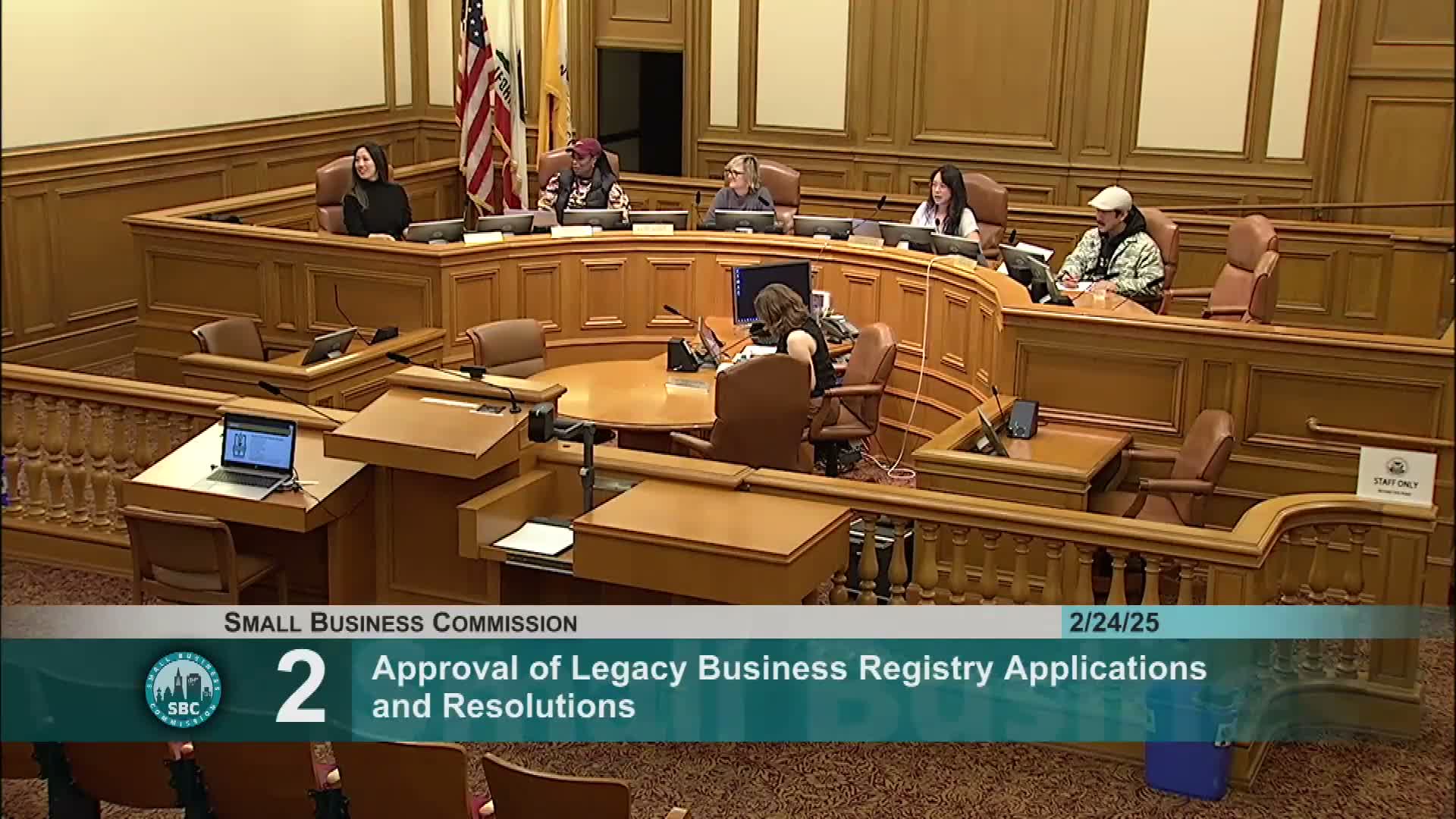
Amanda Eakin, who represents the Office of the Chief of Staff at the San Francisco Municipal Transportation Agency, told the Small Business Commission on Feb. 24 that Muni faces urgent fiscal challenges and that the agency and its Muni Funding Working Group are evaluating a package of potential responses.
Eakin said SFMTA projects a $50,000,000 shortfall for the fiscal year beginning July 2025 and a much larger $320,000,000 shortfall for FY26 (starting July 2026), which she described as a 'fiscal cliff' caused largely by the expiration of one-time federal and state pandemic relief. She emphasized that none of the ideas presented were endorsed and that staff seek community input to craft a balanced package.
Options under discussion included a regional ballot measure coordinated through the Metropolitan Transportation Commission (one scenario estimated San Francisco’s share at about $80–$90 million), local sales-tax increases (discussed in eighth-cent to seven-eighths-cent ranges), local parcel taxes, parking and curb fees including potential fees for short-term curb use by delivery vehicles, a modest increase to the utility-user tax, a commuter-benefit or employer-purchased CLIPPER pass, and joint-development of SFMTA-owned properties (including Potrero Yard and Presidio Yard) to create long-term revenue streams. Longer-term ideas such as road or congestion pricing were listed as requiring substantial community collaboration.
Eakin described other tools being deployed now: transit fare inspection and revenue optimization to reduce fare evasion, parking optimization and potential adjustments to residential parking programs. She noted recent operational progress — higher customer satisfaction ratings and substantial weekend ridership recovery — but also said weekday recovery lags and downtown station exits remain well below pre-pandemic levels (she cited ballpark estimates of downtown station activity at roughly 30–40% of pre-pandemic numbers).
During Q&A, commissioners asked about specific scenarios and the composition and timing of measures. Commissioner Herbert asked whether a sales-tax increase could quickly cover the $50 million; Eakin said ballot measures would not come online fast enough to address the immediate shortfall and that the board is currently identifying options to cover a $50M gap before July. On the composition of the $50M items, Eakin said a scenario presented to the MTA board on Feb. 4 would reduce Muni service by about $15M (approximately a 4% service cut), and that other options were still being explored. On fare changes, Eakin said cash fare was held at $3 and the CLIPPER discount was reduced (CLIPPER product previously $2.50) to align that product closer to cash fare; she cautioned that fare changes were a relatively small portion of the revenue solution.
Public comment reflected both support for additional transit funding and skepticism about agency processes. Richard Corolla, who disclosed prior City employment at the Office of Small Business and spoke as a resident, urged SFMTA to rebuild community trust before asking for new funding, criticizing street closures and a lack of holistic outreach in neighborhoods such as DuBois Triangle/Noe Street.
Why it matters: Muni carries a majority of transit trips that start or end in San Francisco; the scale of the FY26 gap means the agency is considering both near-term cost adjustments and longer-term revenue mechanisms that could affect riders, employers and small businesses. The Muni Funding Working Group is scheduled to finalize recommendations in March and the SFMTA board is expected to workshop packages in April.
What was not decided: the commission did not vote on any revenue measures; Eakin presented options and asked for feedback. Timing and specific measure design remain under development.
Next steps: the Muni Funding Working Group will continue work in March; SFMTA staff will bring refined package options to the board in April and continue outreach to stakeholders including small-business networks.