Get Full Government Meeting Transcripts, Videos, & Alerts Forever!
Get email alerts on the Economic Update topic
No spam. Unsubscribe anytime.
Controller: San Francisco job market shows slow recovery; downtown retail foot traffic still weak
Summary
Ted Egan of the Controller’s Office briefed the commission on economic indicators showing a gradual jobs recovery (unemployment 3.9%), improving transit ridership, but retail foot traffic and hotel revenues remain below pre-pandemic levels.
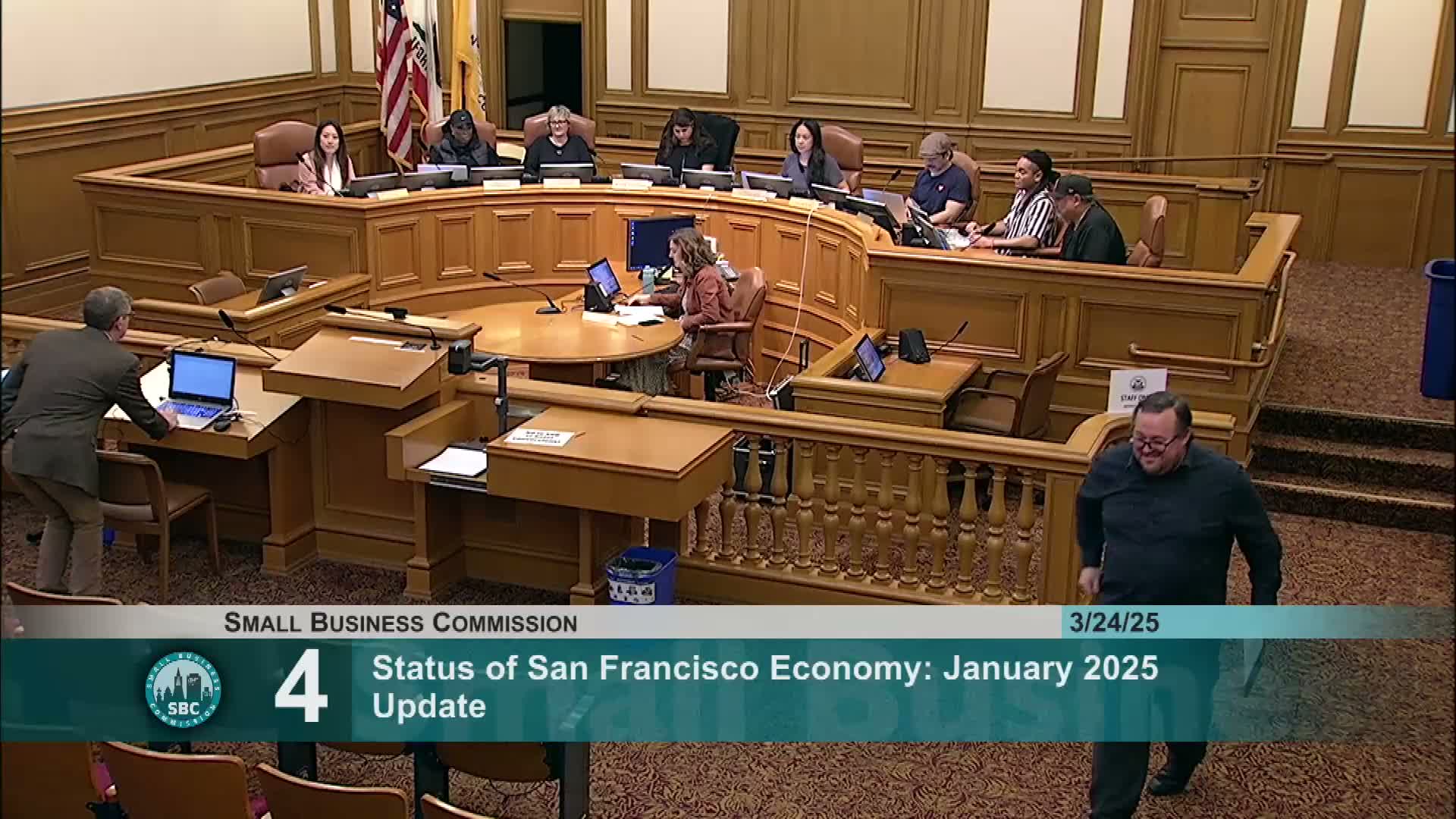
Ted Egan, chief economist at the San Francisco Controller’s Office, presented the office’s bimonthly economic indicators on March 24, describing a slow recovery with mixed signals across sectors.
Key takeaways: Egan said the city’s seasonally adjusted unemployment rate was about 3.9% and that employment has shown slow growth; retail foot traffic (Placer.ai data) was about 65% of normal as of January; apartment rents recorded roughly 5% growth over the past year; hotel revenues were around 70% of 2019 levels; and office-vacancy trends showed a small dip late last year followed by increases in early 2025. "As of December... the city's job market was continuing a slow recovery," Egan said.
Egan cited return-to-office signals (Muni Metro and badge-swipe data) as improving and noted a small uptick in job postings around year‑end, but he said new business formation remains below pre-pandemic rates, particularly in retail and neighborhood services. He also said that an increase in rents partly reflects a constrained housing stock and that building permits remain well below pre‑pandemic levels.
Commissioners asked about neighborhood-level visitor data, construction-permit backlogs, the role of AI and tech leasing, and impacts on middle-income workers. Egan said some tech indicators are flat rather than collapsing and that AI-related leasing has grown, but that rebalancing downtown will take time.
Next step: Egan said the office is finalizing the March report and will provide updated figures, and commissioners requested additional neighborhood-level Placer.ai and permit data for future briefings.