Get Full Government Meeting Transcripts, Videos, & Alerts Forever!
Get email alerts on the Van Ness topic
No spam. Unsubscribe anytime.
Small Business Commission backs removing conditional-use rule on Van Ness to fill large vacancies
Summary
The commission voted to support Board of Supervisors file 250101 to remove conditional-use requirements for formula retail on Van Ness Avenue, endorsing an incremental change to address high vacancy while urging protections for legacy businesses and attention to food-access equity.
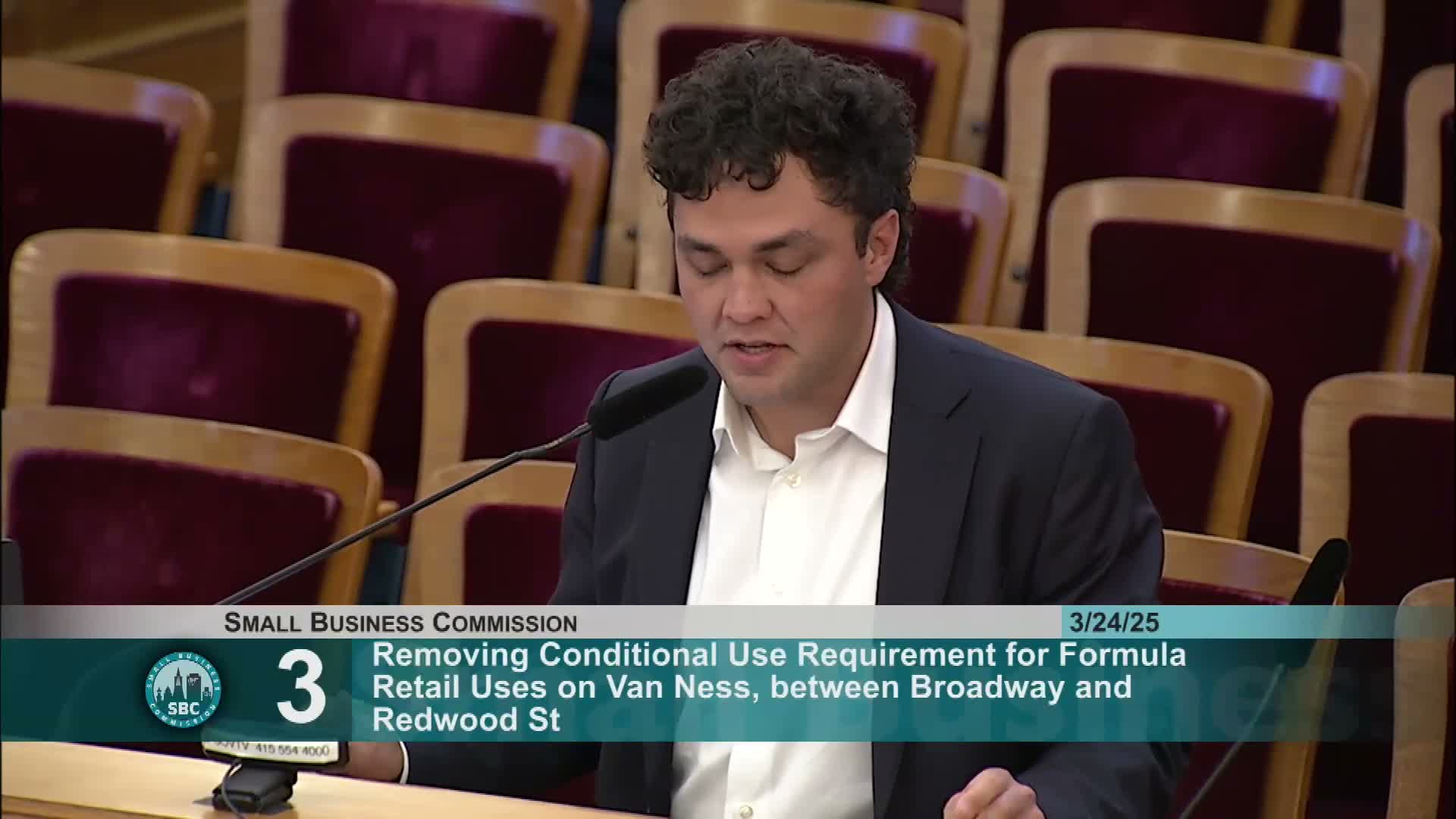
The San Francisco Small Business Commission voted March 24 to support a planning-code change aimed at easing the entry of formula retail along Van Ness Avenue between Broadway and Redwood Street to address persistent large vacant storefronts.
Lorenzo Rosas, legislative aide to Supervisor Cheryl (last name not specified in the transcript), told the commission the corridor has “an over 50% ground floor commercial vacancy rate” compared with a citywide retail vacancy rate of about 7.7% in the fourth quarter of 2024 and said the conditional-use authorization (CUA) process deters potential tenants. “In a time when new business formation remains far below pre-pandemic rates, City Hall should be making it easier to open stores,” Rosas said.
Why it matters: Van Ness is a major north–south arterial where large footprints — some exceeding 20,000 square feet — have sat empty for years, contributors said. Proponents say widening allowable uses could attract businesses able to occupy those large spaces and help revitalize a corridor that shapes visitors’ and residents’ impressions of the city’s economic health.
Commissioners asked for more data and guardrails. Several asked for case studies showing that easing CUA rules would actually reduce long-term vacancy and not simply displace nearby small businesses. Vice President Zizunas moved to support the legislation while adding comments that the city should retain planning tools to protect neighborhood commercial corridors and coordinate resources with adjacent corridors such as Polk Street.
Lower Polk Community Benefit District leader Chris Schulman told commissioners his organization supports keeping formula retail controls on Polk Street but recognizes the distinct conditions on Van Ness. “We remain committed to formula retail controls on Polk Street,” Schulman said, and added that Van Ness’s high vacancy makes incremental changes worth considering while urging protections for legacy businesses.
The commission voted unanimously to support the file, with a motion that the commission’s comments accompany the legislation urging planning-code protections for neighborhood corridors and coordination to avoid harming parallel small-business corridors.
Next steps: The Small Business Commission’s recommendation will accompany Board of Supervisors file 250101 as it continues through the legislative process. Staff and commissioners said they want additional case studies and data on prospective users and food-access priorities before any citywide expansion of the policy.