Get Full Government Meeting Transcripts, Videos, & Alerts Forever!
Get email alerts on the Declaration Reading topic
No spam. Unsubscribe anytime.
Retired teacher Art Dolan traces path to the Declaration of Independence and leads public reading
Summary
At the Lacey Museum’s January History Talks, Art Dolan outlined events from 1774–1776, credited Thomas Paine’s Common Sense with shifting public opinion, and led descendants in a public reading of the Declaration of Independence followed by audience discussion on the document’s modern relevance.
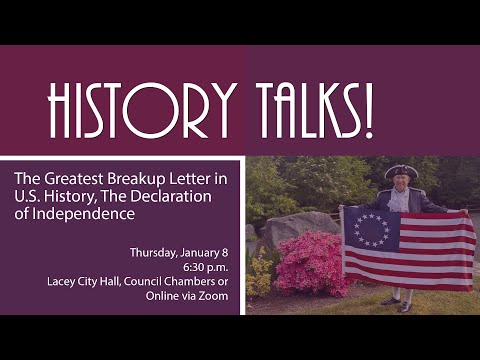
Art Dolan, a retired science teacher who relocated to Olympia in 2005, told a full house at the Lacey Museum’s January History Talks that the road to the Declaration of Independence ran through a series of escalating events in 1775–76 and that Thomas Paine’s pamphlet Common Sense helped make independence politically possible.
Dolan said he would frame the evening in three parts — background, readings, and discussion — and began with a short narrative that traced conflicts from late 1774 through Lexington and Concord in April 1775. He described Lord Dunsmore’s seizure of gunpowder and the Continental Congress convening at Carpenters’ Hall as moments that hardened positions toward separation. “The revolution has begun because the revolution has now drawn first blood,” he said.
Dolan credited Thomas Paine with bringing the argument for independence to a popular audience. He described Common Sense as plain-language persuasion and said it “took off like a fire,” citing (by his account) a first printing of 100,000 copies and an estimated 500,000 copies in 1776 — figures he presented as part of explaining the pamphlet’s reach. Dolan attributed Paine’s use of Locke, Hobbes and Rousseau for the pamphlet’s arguments and called Common Sense “an argument for independence.”
Dolan outlined how the Committee of Five (Thomas Jefferson, Benjamin Franklin, John Adams, Roger Sherman and Robert Livingston) drafted the Declaration and walked the audience through the ratification on July 4, 1776 and the subsequent printing and distribution of copies. He noted the risks signers took, saying the 56 signers knowingly risked charges of treason.
Following Dolan’s remarks, descendants introduced as members of the Sons and Daughters of the American Revolution — Dennis Case, Susan Schumann, Tawny Fortune and Nikki Faust — read the Declaration aloud in sections. Dolan said the document was designed to be heard and invited attendees to reflect on where its language resonated with modern governance.
During the discussion half of the program, audience members drew lines between the Declaration’s grievances and contemporary complaints about officials. One attendee said that some grievances “are still grievances that many people have today against elected officials,” a point Dolan and others used to discuss the document’s continuing relevance. Other comments observed that the preamble’s use of “we” presaged later constitutional development.
Dolan closed by thanking readers and the library system for hosting. Olivia Moore reminded attendees about the Feb. 12 on-site history-talk event and asked people to sign up in person or by email.
The program included audience commentary and questions but no formal decisions or policy actions.