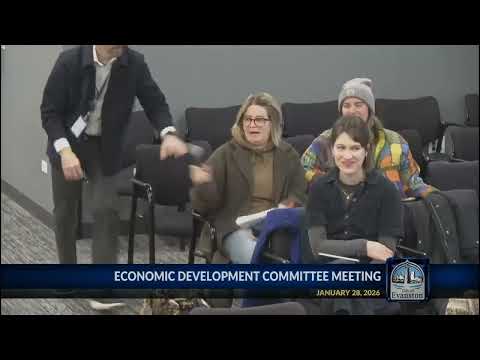
Evanston committee recommends contract for retail pop‑up incubator pilot, debates procurement
Loading...
Summary
The Evanston Economic Development Committee voted to recommend a contract for a retail pop‑up incubator pilot intended to reduce downtown commercial vacancies, approving a staff recommendation while some members urged an open RFP instead of single‑source procurement.
The Evanston Economic Development Committee voted to recommend that the City Council approve a contract to pilot a retail pop‑up incubator program aimed at reducing downtown commercial vacancies and supporting local entrepreneurs.
The committee approved the recommendation in a roll‑call vote after a presentation from Claire Sajovic, an urban development and creative strategist who described a three‑phase plan of assessment, a pop‑up/incubator strategy based on survey results, and implementation. “The goal is to reduce commercial vacancy and revitalize retail corridors while making a low risk entry point for these businesses to share their work with the community,” Sajovic said.
Staff told the committee the proposal asks for a $100,000 investment, with about half coming from the city’s entrepreneurship support fund. “We’re asking for an investment of $100,000, half of which is coming from the entrepreneurship support fund,” a staff member said. Staff also described the work as a near full‑time effort—identifying and negotiating leases, furnishing a space, and curating participants—and said hiring Sajovic to run the pilot would fill a bandwidth and expertise gap.
The committee heard specifics about the Ensemble holiday market that Sajovic ran in downtown Evanston: she said the two‑day market drew roughly 1,100 visitors and participating businesses collected about $20,000 in direct sales, an average of roughly $1,500 per business. Sajovic described possible program timelines: a brief survey and landscape assessment followed by implementation work, with a potential three‑month incubator pilot (October–December) and 3–6 month pop‑up lease rotations depending on survey results.
Several members pressed staff on procurement. Council Member Davis said she did not understand why the city would not issue an RFP or RFQ and asked for more deliberation before approving a single‑source contract. “I don’t understand why we wouldn’t do an RFP or RFQ for this,” Davis said, urging either an additional committee meeting or that staff prepare a referral recommending an RFP. Staff replied that an RFP is possible but would add roughly 90 days to the process and likely delay implementation until 2027, while also noting past experience and a smaller budget footprint compared with prior efforts.
Committee supporters argued the program is a timely, low‑risk pilot that leverages demonstrated local success and could be implemented faster as a single‑source contract so the city can begin placing entrepreneurs in downtown spaces sooner. Staff described landlord options under consideration—revenue share or city‑subsidized rent—to guarantee activation and rent for owners while testing concepts.
The motion recommending contract execution was moved, seconded and passed by roll call (Rogers: Aye; Kelly: Aye; Suffreddin: Aye; Judis: Aye; Nussma: Aye; Deacon: Aye; Davis: Aye). The committee will forward its recommendation to the City Council for final action.
Votes at a glance
- Remote participation: Committee voted to allow Council Member Davis and Committee Member Deacon to participate remotely (motion passed by roll call). - Meeting dates/location: Committee selected meeting schedule/location option 3 to be held at 909 Davis (motion passed by roll call). - Pop‑up incubator pilot: Committee recommended council approve execution of a contract as outlined in the staff memo (roll‑call approval by the committee).
Next steps
The recommendation will be included in a City Council packet for final consideration; staff said they will provide additional procurement background and budget breakdowns to the committee and council on request.