Department of Neighborhoods highlights 311 modernization and community grants in 2026 budget presentation
Summary
Director Kim Douglas told Columbus City Council’s Neighborhoods Committee that 311 service requests rose nearly 50% over three years and outlined plans to modernize the system, protect core grants through capacity-building and adjust programs amid modest budget reductions.
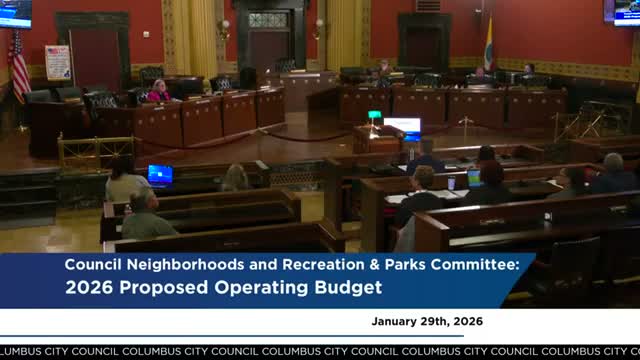
Kim Douglas, director of the City of Columbus Department of Neighborhoods, presented the department's proposed 2026 operating budget to the Columbus City Council Neighborhoods, Recreation and Parks Committee and emphasized plans to modernize the city's 311 system, sustain community grants through capacity-building, and manage modest reductions largely through vacancies rather than layoffs.
Douglas said requests to the city's 311 system increased ‘‘nearly 50%’’ over the past three years and reported 4,544 service requests (SRs) received between Jan. 25 and the hearing. She said the department will diversify channels — app, email and other digital contacts — so residents can get real‑time updates and so 311 can move toward an 85% calls-answered-in-20-seconds goal that is currently near 60%.
The department framed the cuts as small and targeted. Douglas told councilmembers that several staff vacancies were used to generate savings; she said those vacancies were not layoffs and that some positions shown as removed in the budget book were later restored. On grant-funded neighborhood programs, Douglas described a capacity-building accelerator that helps nonprofit grantees document impact and pursue philanthropic funding to reduce single-source dependence on city dollars.
Douglas highlighted recent neighborhood planning work: Eastland For Everyone, Envision Hilltop and the 1 Linden plan. She said many consulting costs for those plans were front-loaded in earlier years and that implementation is shifting to locally led CDCs and partners to keep the plans active without recurring high consultant fees.
Councilmembers pressed on translation services and line items for blight and illegal dumping. Douglas confirmed there is a citywide budget allocation for translation services. On illegal dumping and blight spending, she described a contract with the Center for Employment Opportunities (CEO) that supplements Department of Public Service (DPS) capacity in narrow alleys and hot spots; CEO employs returning citizens and performs pickups and hotspots work that complement DPS equipment and weekly routes.
Multiple councilmembers, including Council Member Boyce and Councilmember Remi, pressed for clearer 311 front‑end messaging so residents do not receive ‘‘closed’’ tickets when the issue is referred elsewhere. Douglas said the department is in active conversation with its vendor and the Department of Technology to change the public-facing language from closed to a more informative status and to integrate downstream systems so residents see progress in real time.
The department introduced short testimonial segments from community partners to illustrate program impact: Student Success Stores (school-based stores providing hygiene, food and school supplies; a $10,000 city grant funded a new store at Briggs High School and the group currently serves about 80 students in two West Side schools with an 11-school waiting list), NALA (New American Leadership Academy) graduates describing leadership development, Families Flourish (rental and coaching support for lower-income families) and Girls LEAP (mentoring and STEM programming for girls). Those presentations were highlighted during the hearing as examples of how departmental funding supports direct services.
The Committee did not take formal votes at the hearing. Chair Nancy Day Akkower thanked staff and members and said the administration and council would continue to work through the budget cycle to protect core services.