Get Full Government Meeting Transcripts, Videos, & Alerts Forever!
Get email alerts on the Well Permit Hearing topic
No spam. Unsubscribe anytime.
Contested Green Hills Ranch well permit generates technical and procedural dispute; evidentiary hearing continued to Feb. 13
Summary
A public quasi‑adjudicatory hearing on Green Hills Ranch's proposed new/replacement well produced competing technical analyses about drawdown and material injury to nearby domestic wells; the board received evidence and continued the hearing to Feb. 13 for closing arguments and further deliberation.
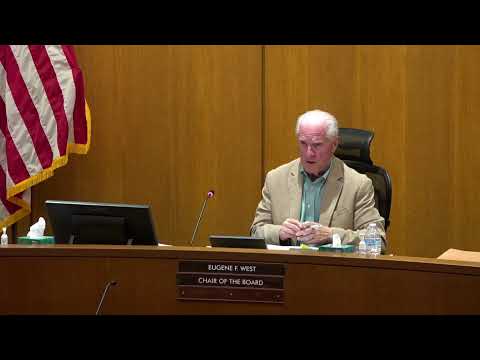
A contested hearing on a proposed new well for Green Hills Ranch drew legal counsel, hydrologists and multiple affected parties to the Fox Canyon boardroom for technical testimony and procedural argument.
The hearing arises under section 4.14 of the LPV adjudication judgment because the proposed well moves a point of extraction more than 300 feet and triggered notice to surrounding well owners. The City of Ventura and Del Norte Mutual Water Company filed protests and asked the board to continue the hearing because they said a technical staff report and proposed operational conditions were circulated only days before the meeting. The city and Del Norte said they needed additional time to evaluate the technical analyses and the operational thresholds staff proposed.
Staff hydrologist Robert Hampson presented an interference analysis using analytical methods (Theis/TICE equation) and calibrated values and reported modeled drawdown at a nearby well in a high‑stress scenario (a 120‑hour, 950 gpm pumping test) but concluded the available evidence and local recharge patterns make it unlikely the proposed well would cause an unreasonable material injury; he recommended conditional permit terms as a backstop. In his words, staff "didn't find that this rose to a point of an unreasonable material injury." (Robert Hampson)
Applicant counsel and experts said the well is permitted under the judgment, the owner has an allocation, and pumping at realistic operational rates is intended to replace water previously received from Del Norte rather than increase basin demand. The applicant's hydrogeologist modeled interference with more conservative storativity values in some runs and said impacts would be small.
Objectors presented counter‑analysis and testimony. Curtis Hopkins (Del Norte/City consultant) and the City and Del Norte raised three recurring concerns: (1) the staff and applicant analyses rely on a single‑well analytic solution that can miss complex local heterogeneity and multi‑well interactions typical of the basin; (2) storativity and transmissivity inputs heavily influence modeled drawdown and parties used different values; and (3) the proposed operational trigger in staff conditions (an elevation threshold near a record low) may not prevent material injury because those triggers could allow injury to occur before mitigation steps are required. The City asked that Saticoy Well No. 3 be explicitly included as a monitoring well to trigger actions if the city's water levels decline.
The board heard expert cross‑examination and received demonstratives and written submissions. Given objections about late materials and the technical complexity, the board heard presentations, received evidence, and then suspended the hearing for a February 13 special meeting to permit brief closing arguments and board discussion. The meeting was adjourned into a closed session after the continuation was set.
Next steps: evidence in the record; parties will submit further analysis and closing arguments at the Feb. 13 continuation; the board signaled staff and parties should try to coordinate on potential permit conditions and mitigations before that date.