Get Full Government Meeting Transcripts, Videos, & Alerts Forever!
Get email alerts on the Transportation topic
No spam. Unsubscribe anytime.
Tolland staff outline traffic-safety fixes after crashes at Goose/Anderson; study and speed-camera discussion planned
Summary
Staff and outside experts presented recommendations for the Goose Lane/Anderson Road intersection and the high-school drop-off area, including new reflective sign strips, painting stop bars in spring, targeted pavement markings, and a planned traffic study ahead of any speed-camera or ordinance action.
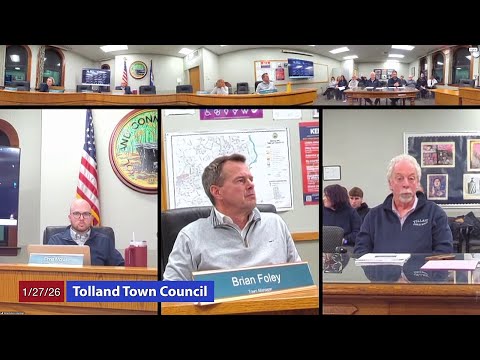
Town staff and outside experts briefed the council on traffic-safety concerns on Jan. 27, focusing on Goose Lane/Anderson Road and the high-school drop-off area.
Town Manager Brian summarized recent complaints and crashes and said staff engaged the University of Connecticut Transportation Institute (T2) and local traffic authorities for a site assessment. Police and traffic personnel described the collision patterns and noted sight-line and grade issues at the Goose/Anderson intersection.
T2's recommendations included adding an extra red reflective stripe to existing signage (which staff installed), painting stop bars at the approaches (deferred until spring because of weather), and using specialized pavement markings to create a visual narrowing that can slow approaching drivers. T2 advised against installing convex mirrors at the high-school site because mirrors can create a false sense of visibility.
Councilors and staff discussed trade-offs about adding or removing stop controls; T2 cautioned that eliminating one of the three stop controls could increase speeds on the remaining approaches. Staff said they will implement low-cost recommendations and continue monitoring; enforcement was raised as an ongoing component, and the town has requested additional enforcement from the resident trooper's office.
The town manager said a speed-camera company will present at the next council meeting; that process would begin with a traffic study and public input and would require any ordinance or resolution before enforcement could begin.
What happens next: staff will implement T2's low-cost recommendations (reflective stripes and, when weather permits, painted stop bars), pursue additional enforcement as appropriate, and present a traffic-study and speed-camera discussion at the next council meeting for public input.