Lifetime Citizen Portal Access — AI Briefings, Alerts & Unlimited Follows
President signs executive order launching 'Great American Recovery Initiative' to expand addiction treatment and prevention
Loading...
Summary
In a White House Oval Office event, the president signed an executive order establishing the Great American Recovery Initiative, pairing federal agencies, private partners and personal testimonies to emphasize prevention, treatment, coordination and reduced stigma for people with substance use disorders.
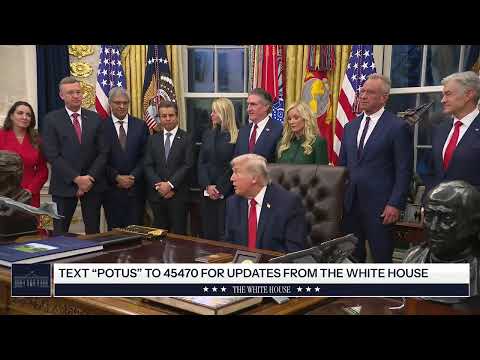
The president signed an executive order in the Oval Office establishing the Great American Recovery Initiative, a cross-government effort the administration described as aligning federal, state, local and private resources to prevent addiction, expand treatment access and support long-term recovery. The president said the order "will help mobilize the full resources and authority of the federal government to help stop this tremendous plague." (SEG 007)
Robert F. Kennedy Jr., identified in remarks as a co-chair of the initiative, described addiction as "a disease... chronic... treatable" and said the initiative would set "clear, measurable goals" and align leadership across health, justice, labor, housing, veterans and education. Kennedy characterized the action as a shift "from fragmentation to coordination" and pledged "urgency, accountability, and honesty." (SEG 132)
Catherine Burgum, introduced as senior advisor to the White House Great American Recovery Initiative and speaking as a co-chair, gave a personal account of long-term recovery and urged ending stigma. "Never give up hope for recovery," she said, and framed the initiative as treating addiction like other chronic diseases so that early intervention and sustained care are expected rather than exceptional. (SEG 239)
Agency leaders described research and regulatory steps tied to the initiative. A speaker identified in the transcript as the FDA commissioner said the agency is pursuing expedited pathways for promising therapeutics and noted community supports as an important component of recovery. The NIH representative referenced the 2018 HEAL initiative and credited research investments with producing non-opioid treatments and saving lives. (SEGs 463, 477)
Speakers at the event offered numerical claims about the crisis and enforcement results. The president said the administration estimates "an estimated 300000 people" lost annually to drug and alcohol abuse, that overdose deaths "plummeted by 21 percent in the last year," and that authorities seized "over 47,000,000 fentanyl pills and 10,000 pounds of fentanyl powder." He also asserted that drugs entering by sea are "down 97%" and described other interdiction activity. These figures were presented by speakers as factual claims during their remarks; they are reported here as statements made at the event and were not independently verified in the text. (SEGs 081–090, 100)
The White House framed the initiative as a whole-of-government response involving health agencies, law enforcement, housing and faith communities, as well as private partners. Participants included private-sector guests mentioned by the president, who said they had built American companies that support the work. Personal testimonies — including from a speaker who said he lost a son to addiction — punctuated the signing and underscored the administration's emphasis on lived experience and recovery leadership. (SEGs 053–070, 388–415)
The president said further major announcements tied to the initiative would follow next week and closed the event with thanks to participants. (SEG 223, SEG 521)