
Nevada County presents 2025 achievements and budget outlook; public comments press housing, broadband and public‑safety choices
Get AI-powered insights, summaries, and transcripts
Sign Up Free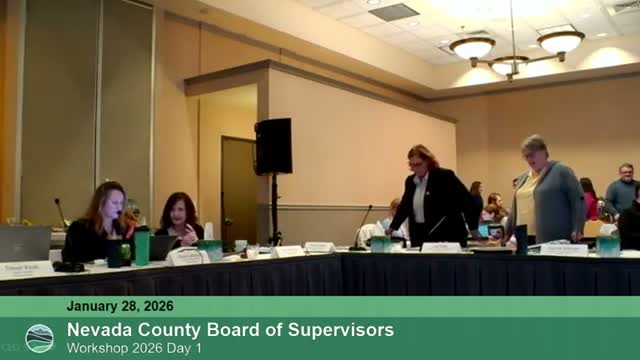
Summary
County leaders reviewed a year‑in‑review, communications growth and a cautious 2026 budget plan; public comment raised concerns about housing, the RV ordinance, telecom expansion, and the relative priority of a sheriff firing range versus neighborhood wildfire mitigation.
Nevada County staff used the workshop to present a 2025 year‑in‑review and a cautious budget outlook for 2026, and to solicit policy direction. Taylor Wolf, public information officer, said county digital reach and engagement increased in 2025 (county website ~2.2 million page views, newsletter 51% open rate, strong social growth). Assistant CEO Patrick Eidmon framed the review as a foundation for community‑focused priorities in 2026.
Erin Mettler, deputy CEO and chief fiscal officer, told the board the county will publish a draft budget in May and recommended a two‑day April workshop for all five supervisors to review department proposals earlier than the old chair/vice‑chair subcommittee model. Mettler outlined fiscal posture: an unaudited available fund balance near $36–37 million, a plan to present a pension management proposal in spring (including possible Section 115 trust options), and contingency planning if HR 1 implementation increases local costs.
Public comment covered multiple topics. Paul Elias questioned the relative priority of an indoor firing range (estimated earlier in discussion at $10–17 million in federal/local funds) versus neighborhood wildfire mitigation and proposed a local microloan program for fuel removal. Speakers from Nevada County for SafeTech and others urged a protective telecom ordinance and a fiber‑first approach for broadband funds; commenters from arts and economic groups emphasized the role of small businesses and cultural districts in economic recovery. Several residents described personal disaster experiences and the value of neighborhood networks.
County staff reiterated that some project funds are assigned or restricted by policy and that many discretionary priorities will be assessed as part of the upcoming budget process. The board asked staff to continue refining contingency planning around HR 1 and pension choices and to return with clearer fund‑balance policy language.
Next steps: the county will hold the proposed April budget workshop for all supervisors, continue interjurisdictional coordination with cities and towns, and run public outreach and follow‑up on broadband, housing and small‑business strategies.