
Board adopts countywide stormwater master plan after two‑year study; 23 concept projects identified
Get AI-powered insights, summaries, and transcripts
Subscribe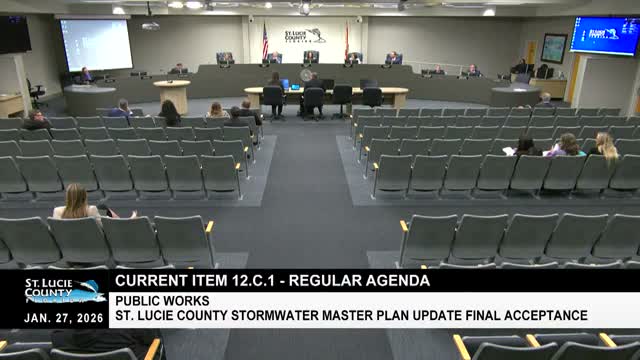
Summary
After a two‑year planning process with Tetra Tech, St. Lucie County adopted an updated stormwater master plan (first since 1992) identifying 23 concept projects across five basins and a 20‑year implementation horizon; the board approved the plan and staff recommended next steps for surveys, geotechnical work and funding strategy.
Public Works staff and consultant Tetra Tech presented the county's updated stormwater master plan, the first comprehensive update since 1992. The presentation described a two‑year effort that included interviews with commissioners and cities, public workshops, county‑wide modeling, and the identification of priority basins and potential project locations.
Consultant Marcy Frick said the team started with about 132 candidate locations and narrowed them to 41 evaluated sites, then developed high‑level concept designs for 23 projects that include estimated runoff reduction and nutrient‑reduction benefits and order‑of‑magnitude costs. The plan divides actions into a 20‑year horizon with projects grouped into a first 10 years (focused on existing flooding) and a second 10 years (addressing future development and sea‑level rise scenarios).
The plan also recommends countywide measures to improve operations and maintenance — for example, continued promotion of the county’s driveway culvert assistance program and enhanced maintenance of swales and ditches — and identifies potential comp‑plan and ordinance amendments to support resilience.
The board voted to adopt the final master plan on staff recommendation. Staff said further steps before construction will include targeted surveys, geotechnical studies, refined benefit/cost estimates and identification of funding sources for each project.