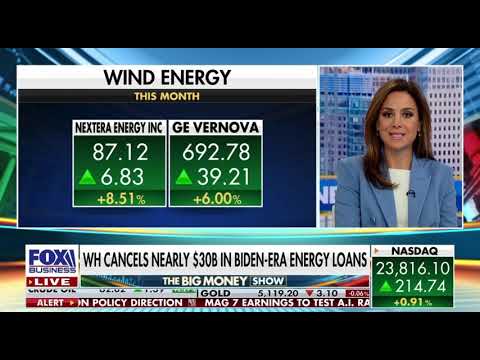
Administration cancels nearly $30 billion in Biden-era green loans; DOE secretary says loans wouldn’t lower consumer costs
Get AI-powered insights, summaries, and transcripts
SubscribeSummary
The Trump administration announced cancellations of about $30 billion in clean-energy loans and revisions to another $53 billion. Energy Secretary Chris Wright told a news panel the funds ‘‘wouldn’t lower the cost of energy for Americans,’’ while panelists raised legal, geopolitical and corruption concerns.
The Trump administration has moved to cancel about $30,000,000,000 in Biden-era clean-energy loans and revise roughly $53,000,000,000 more, with the Department of Energy saying much of the late-term funding did not advance lower consumer energy costs, according to an on-air discussion featuring an interview with Energy Secretary Chris Wright.
Secretary Wright told the program that "as you looked at that 100,000,000,000 that was committed to loans, precisely 0 of it was gonna do something that was gonna lower the cost of energy for Americans or expand the production of reliable, affordable energy for Americans." He framed the prior loan commitments as politically driven by climate priorities rather than consumer benefit.
Why it matters: the Department of Energy also halted hundreds of projects and canceled grants during a review. The program reported that in October the DOE canceled nearly $8,000,000,000 in grants supporting projects across 16 states and had halted 223 projects after a "thorough individualized review," a move that affects developers and local economies where those projects were planned.
Details from the interview and coverage Secretary Wright and the program repeated two related claims: that an unusually large amount of financing was dispersed in the Biden administration’s final months and that the DOE subsequently eliminated about $9,500,000,000 in financing. The secretary urged public engagement on regional energy choices, telling listeners that residents in New England should "engage with their local politicians and regulators and express your desire to have more secure, lower cost energy" and characterizing the Constitution Pipeline as "ready to be constructed." The program’s reporting included an on-air statement that the final months had more disbursements than the previous 15 years combined.
Panel reactions and context Panelists on the program offered differing views. One panelist argued the late-year funding was earmarked for pet projects and said reclaiming funds could redirect investments into infrastructure such as pipelines. Another panelist criticized green-energy spending on geopolitical grounds, saying policies had pushed Europe to buy oil from Russia and that global elites had stepped back from ESG priorities. A separate panelist raised corruption concerns, citing past cases such as Solyndra and saying green programs can "directly benefit corrupt politicians." A different commentator warned that efforts to "claw back" loans would face court challenges and said Congress bears responsibility because it authorized the spending.
What was not decided There was no legislative vote or formal regulatory decision announced on air during the segment. Panelists anticipated legal challenges and disputed whether the loans would have produced the consumer benefits the DOE described. The broadcast did not identify the specific projects or individual officials referenced when panelists said a majority of Northeast officials favored the Constitution Pipeline.
Next steps According to the program, the DOE review led to halted projects and canceled grants; panelists predicted litigation over clawbacks and said congressional action would be required to change the underlying appropriation process. The segment closed with a transition to coverage of a winter storm’s continuing impacts.