Get Full Government Meeting Transcripts, Videos, & Alerts Forever!
Get email alerts on the Lighting Ordinance topic
No spam. Unsubscribe anytime.
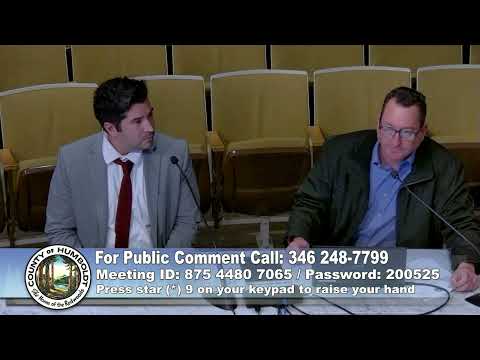
Planning Commission approves inland and coastal outdoor lighting ordinances, adds agriculture and flags streetlights for board review
Summary
After public comment and line-by-line review, the Humboldt County Planning Commission adopted inland and coastal outdoor lighting ordinances (to go to the Board of Supervisors) that set fixture limits (1,000 lumens residential; 3,000 lumens commercial/industrial), require 2,700K color temperature, and allow conditional-use exceptions for noncompliant commercial/industrial and agricultural uses.
The Humboldt County Planning Commission voted unanimously to approve inland and coastal outdoor lighting ordinances and forward them to the Board of Supervisors with several modifications and a comment asking the Board to consider streetlights separately.
Planner Rhianne Megan told the commission the draft aims "to promote safety, protect and preserve our nighttime skies and address community complaints," and staff recommended a general rule that fixtures be fully shielded or have a correlated color temperature of 2,700 kelvins. In response to public comment, staff proposed maximum illumination limits of 1,000 lumens for residential fixtures and 3,000 lumens for commercial and industrial fixtures.
Commissioners debated how to handle exceptions. Staff removed a special-permit pathway and instead proposed that any deviation for commercial or industrial projects be handled through a conditional use permit (CUP) so surrounding property owners would receive notice and the commission could consider a public hearing. Commissioners agreed to add "agricultural" to the list of uses eligible for the CUP exception so large rural and working properties could seek higher illumination when necessary.
During the discussion commissioners questioned whether streetlights belong in the ordinance. Director Ford said streetlight standards are generally set by Public Works and adopted by the Board of Supervisors; the commission directed staff to include a comment to the Board noting substantial public concern about streetlights and offering the Planning Commission's assistance in review for consistency with the new ordinance.
Public commenters urged strict protection of dark skies. Veil Petk Krause, a farmer in the Arcata Bottoms, said she was "grateful" for the opportunity to see stars and asked the commission to use Dark Sky International standards where practicable. A phone commenter also asked how the draft deals with very bright highway electronic signs; staff replied sign lighting is regulated under the county sign ordinance and by the Outdoor Advertising Act.
The approved draft also clarifies enforcement and definitions: staff removed references to "glare" (addressing it instead through light trespass and light pollution rules), added a definition for "lighting nuisance" and clarified that the planning director would handle nuisance complaints through code enforcement with appeal rights. The ordinance replaces the prior term "nonconforming lighting" with "preexisting lighting" to avoid confusing land-use terminology.
The commission's motion, approved by voice vote, adopted the staff recommendations and the commission's changes (including adding agriculture and requesting Board review of streetlights). The ordinance now moves to the Board of Supervisors for formal adoption; staff noted ordinances become effective after Board adoption and any statutory waiting period in the code.