Get Full Government Meeting Transcripts, Videos, & Alerts Forever!
Get email alerts on the Science King Tides topic
No spam. Unsubscribe anytime.
NOAA meteorologist explains king tides to Humboldt Bay board: alignment, ellipses and storm compound risks
Summary
Troy Niccolini of the National Weather Service, Eureka, told the board that king tides result from lunar and solar alignment, Earth tilt and orbital ellipses, and warned that when high tides align with storms and river runoff impacts can be compounded.
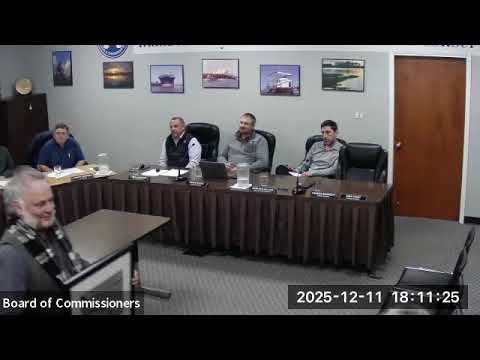
Troy Niccolini, Meteorologist in Charge at the National Weather Service in Eureka, gave the Humboldt Bay Harbor, Recreation and Conservation District a plain‑language briefing on tides and king tides, using a physical model to illustrate how the moon and sun create near‑side and far‑side tidal bulges.
Niccolini explained that proximity matters: when the moon is closer to Earth (an elliptical orbit) and the sun and moon align, the combined gravitational effect raises higher tides. He described how Earth’s axial tilt and the moon’s moving ellipse mean king tides are episodic and sometimes stronger in winter: "We get our most severe king tides in the winter because of that's one of the major factors," he said.
Niccolini emphasized that king tides by themselves can be notable but that the greatest local impacts occur when king tides coincide with storms and river runoff. He advised that if a sequence of landfalling fronts produces persistent strong south winds and a supermoon aligns with the sun and Earth, tides and storm surge can combine to create especially damaging conditions.
In response to board questions about why tides have been higher than predicted in recent seasons, Niccolini said tide predictions are statistical and can fail to capture anomalous behavior; he suggested staff contact the National Weather Service for assistance in distinguishing prediction error from storm‑driven surge. He also noted that continents complicate tidal behavior in bays and estuaries and that smaller inland water bodies show much smaller tidal ranges.
The presentation concluded with an offer to provide guidance to district staff and an acknowledgement that interactive public materials and recordings (the event was recorded) could help local stakeholders better understand timing and risk of compound events.