Get Full Government Meeting Transcripts, Videos, & Alerts Forever!
Get email alerts on the Public Safety topic
No spam. Unsubscribe anytime.
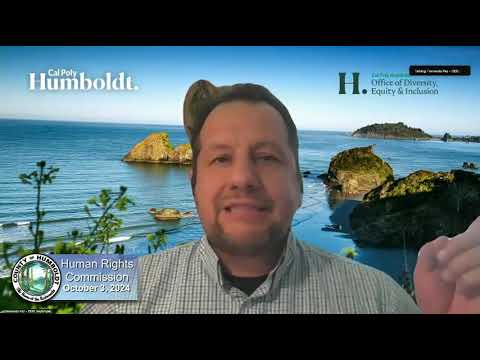
Sheriff briefs Human Rights Commission on oversight, neutral observers and homelessness response
Summary
An unnamed Humboldt County sheriff spoke to the Human Rights Commission supporting a trained neutral-observer program, describing homelessness as driven by addiction and mental health, discussing navigation-center plans, missing-persons reporting changes for tribes, and answering commissioner questions about DOJ and after-action reviews. (350 characters)
An unnamed Humboldt County Sheriff briefed the Humboldt County Human Rights Commission on law-enforcement oversight, neutral observers for protests and local homelessness and public-safety responses.
On oversight, the Sheriff said he believes the Human Rights Commission, the grand jury and existing processes can provide meaningful oversight and cautioned that an additional non-binding sheriff oversight board could create "an extra layer of bureaucracy." He nonetheless said he is available to meet with any oversight committee and explicitly supported training a small, well-trained group of neutral observers who understand basic law and tactics so they can ask timely questions during protests.
The Sheriff framed homelessness as a problem driven primarily by drug addiction and mental health, argued for increased access to dual-diagnosis treatment and for navigational/day-center services to steer people toward long-term care. He described a county-city partnership to develop a navigation center on Third Street and said he supports temporary safe-parking or camping sites with services attached as a way to direct people to help. He referenced Proposition 36 in the context of judicial options that could increase accountability for repeated offenders while noting the limits of local resources.
Commissioners and public commenters raised several concerns: one commenter warned against calling law enforcement as the primary mental-health response and recommended 24/7 mobile mental-health clinicians; another noted homeless encampments along the Hammond Trail and urged bike patrols or wellness checks. The Sheriff replied that sleeping on the Hammond Trail is illegal on public property, that deputies patrol the trail, and that the sheriff's office collaborates with county services and tribal partners. He described mechanisms for reporting missing people (including deputies filing reports to state and national missing-person systems and tribal authorities requesting a "feather alert") and expressed disappointment that Governor Newsom vetoed a pilot bill that would have granted state peace-officer powers to certain tribal police.
On accountability and investigations, the Sheriff said DOJ investigations into a local shooting are ongoing and taking longer than expected; he said after-action reviews (including at Cal Poly) exist and that some reports should be public once finalized. The Sheriff urged the commission and public to file complaints when appropriate, and he offered follow-up communication if members find specific failures in service.
No formal action was taken during the Sheriffs presentation; commissioners agreed to continue discussing neutral observers, rapid response protocols and training at a future meeting.