Get Full Government Meeting Transcripts, Videos, & Alerts Forever!
Get email alerts on the Infrastructure Heavy Lift Terminal topic
No spam. Unsubscribe anytime.
Humboldt Bay district says heavy‑lift terminal work to resume next year; DEIR targeted for 2027
Summary
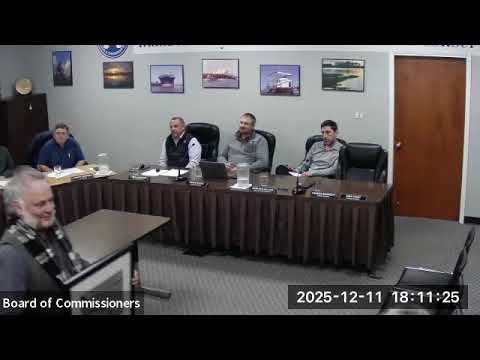
District staff told the board the Humboldt Bay heavy‑lift marine terminal project is temporarily paused while state grant budgets are reconfigured, with preconstruction and studies expected to restart in January and a draft EIR presentation to the board possible by March 2027.
The Humboldt Bay Harbor, Recreation and Conservation District told commissioners that the heavy‑lift marine terminal project — a key element of regional offshore wind and port expansion plans — is on a temporary pause while staff reconfigure state grant budgets. The district’s project lead said the team “anticipate[s] being completely back in action in January,” and outlined a tentative timeline for permitting, studies and public engagement.
The lead described a sequence of technical work: field sampling, dredge material testing and modeling, and a suite of studies planned to start next March. By June, the district hopes most studies will be complete so the impacts analysis can proceed, and the project lead said a draft environmental impact report (DEIR) could be presented to the board by March 2027 to meet existing grant deadlines. The presentation would include CEQA impacts, a public comment period and subsequent direction from the board.
The staff update said mitigation site construction (wetland and eelgrass restoration) could begin as early as 2027 if the schedule holds; the earliest construction start for the terminal’s wharf and uplands was estimated as 2029. The lead cautioned the schedule is speculative and contingent on resuming studies and on grant terms: “As we understand it, there are no possible extensions of the grants that we're working with here.”
Board members asked how committee recommendations from seven community advisory groups will be recorded and reflected in CEQA documents. The project lead said committee findings will be presented to the board and that many recommendations are already being implemented; staff said they maintain detailed agendas, attendance lists and minutes and will report back on memorialization procedures at the next update.
Next steps described to the board include resuming monthly technical briefings, scheduling community advisory committee meetings and planning public outreach and an open‑house event ahead of formal CEQA hearings.