Get Full Government Meeting Transcripts, Videos, & Alerts Forever!
Get email alerts on the Land Use Zoning topic
No spam. Unsubscribe anytime.
Humboldt County adopts McKinleyville town‑center zoning after heated debate over Central Avenue lane reduction
Summary
The Humboldt County Board of Supervisors certified a final EIR and adopted a zoning ordinance to create a McKinleyville Town Center (mixed‑use with a Q overlay) while splitting a contentious question: the board left Central Avenue design for future study but directed staff to prioritize a possible Hiller Road interchange study. Vote: 4–1.
The Humboldt County Board of Supervisors on Monday certified a final environmental impact report and adopted a zoning ordinance to create a McKinleyville Town Center — a mixed‑use, form‑based zone with a Q (qualified) overlay — after a daylong hearing that centered on a proposed lane reduction on Central Avenue and the treatment of wetlands.
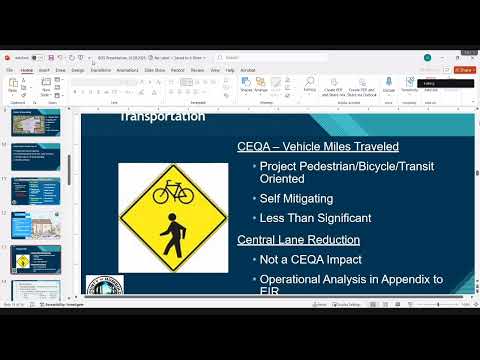
John Ford, planning director, told the board the project grew from a years‑long community process led by the McKinleyville Municipal Advisory Committee and that the EIR examined a conservative “theoretical maximum” build‑out. The analysis flagged one significant unavoidable impact: an increase in traffic noise along Railroad Drive of roughly 5–7 decibels. Ford said vehicle‑miles‑traveled analysis found most traffic impacts to be less than significant because the town‑center plan emphasizes walking, bicycling and transit.
“The recommendation to the Board of Supervisors is to adopt the resolution to certify the EIR and adopt the findings,” Ford said in his presentation, and recommended adopting the mitigation monitoring and reporting program and rezoning the town‑center area to mixed use with the Q overlay.
Why it mattered: the ordinance sets development rules intended to produce a more pedestrian‑oriented downtown — ground‑floor commercial uses, residential above, pedestrian and bicycle connections and required open space. Staff said the ordinance requires 3 percent of undeveloped acreage be set aside as open space with at least one public site of 20,000 square feet minimum, and described a proposed 14‑acre wetland conservation area. The EIR analyzed a theoretical maximum of about 2,650 dwelling units across the entire town‑center acreage but staff stressed that only about 54 undeveloped acres remain today and that those numbers are conservative planning assumptions, not entitlements.
Public testimony split sharply over a proposed Central Avenue “road diet” that would narrow a defined half‑mile segment to a three‑lane cross section (one lane each direction plus a center turn lane) with buffered bike lanes and sidewalks. Opponents raised concerns that reducing lanes would cause congestion, block emergency access and hurt small businesses. “This plan can’t go forward until you do a professional comprehensive traffic study,” said Brenda Rosdahl, a longtime McKinleyville resident. Supporters said slowing traffic would make crossings safer, improve walkability and help local businesses thrive. “We want a heart of McKinleyville,” said Mary Burke, chair of the McKinleyville Municipal Advisory Committee, urging adoption.
Kelly Garrett, a public commenter, argued the ordinance “represents development uncoupled from safety and major deviations from the general plan” and raised procedural complaints about notice and ministerial approvals. Ford responded directly to several process and permit concerns, saying, “That is not a true statement,” when asked whether wetlands could be relocated by an administrative permit without required discretionary approvals. He reiterated that wetlands work would still require applicable permits and that ministerial review for some routine projects is consistent with the community plan as adopted.
Traffic and the Hiller interchange: board members and staff also discussed a longer‑range circulation question raised during the hearing — whether Caltrans might add an on‑ and off‑ramp at Hiller Road to Highway 101. Supervisors and public works staff described that option as a potential game changer for local circulation and urged the county to prioritize studying the concept with regional partners. The planning director said Central Avenue improvements would require separate design and funding and that the town center could be built even if the lane‑reduction is not immediately implemented.
The vote and next steps: Supervisor Steve Madrone moved to certify the final EIR, adopt the required findings (including a statement of overriding consideration for the unavoidable noise impact), adopt the mitigation monitoring program and approve the zoning ordinance to rezone the town center to mixed use with a Q overlay. The motion added direction that county staff bring back consideration of the Hiller Road interchange and associated prioritization. The motion was seconded and passed 4–1 (Supervisor Rex Bone opposed). The board did not adopt a specific, immediate lane‑reduction construction plan for Central Avenue; staff said any future designs or construction would require separate engineering work, coordination with McKinleyville advisory bodies and, where applicable, funding and return to the board for project approval.
What remains unresolved: opponents asked for a new, community‑wide traffic study; supporters said additional planning is already identified and that deferring the ordinance would stall affordable‑housing and town‑center projects such as Life Plan Humboldt. The board’s action certifies the EIR and establishes the zoning framework; details for Central Avenue design, wetland mitigation timing and open‑space siting will be addressed through subsequent design and permit steps.
The decision: the board certified the EIR and adopted the McKinleyville Town Center ordinance, with staff directed to pursue coordination and further study on circulation and the Hiller interchange option; the measure passed 4–1. The board adjourned after the vote.