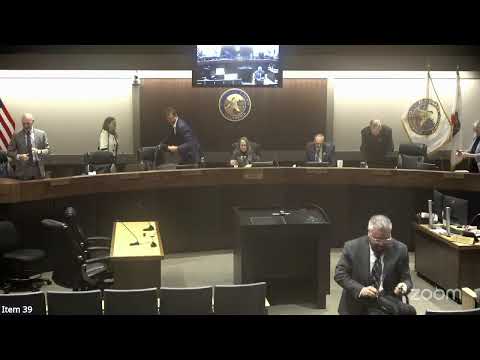
El Dorado County approves environmental review, planning funds for navigation center replacement

El Dorado County Board of Supervisors · January 28, 2026

Loading...

AI-Generated Content: All content on this page was generated by AI to highlight key points from the meeting. For complete details and context, we recommend watching the full video. so we can fix them.

Summary

County staff outlined a shift to a smaller, treatment-focused navigation center and a conservative timeline that closes the existing site in March 2027. The board authorized environmental analysis and delegated procurement authority for design services to advance planning for a new facility intended to serve roughly 30 people.

El Dorado County officials on Jan. 27 received a staff presentation on a revised plan for the county’s navigation center and voted to authorize environmental analysis and procurement for design and planning services.

Olivia Byron Cooper, director of the county Health and Human Services Agency, told the Board of Supervisors the county was instructed in September to develop a more sustainable model for the navigation center that shifts toward a mandatory treatment-based approach and away from the earlier low-barrier, housing-first model. She said the revised plan would focus resources where they believe services will lead to the greatest chance of permanent housing, and that the proposed new site would house “approximately 30 individuals and families with children.” Cooper added, “We won’t be able to find housing for everyone exiting the navigation center now either,” and warned the county lacks resources to house all people who may be displaced when the current site closes.

Staff described a conservative timeline that estimates an operational close of the current 299 Fairlane site in March 2027 and a construction-completion horizon in mid-2028 for the new site; that gap creates a roughly 16-month window the county must address to avoid loss of interim shelter capacity. Cooper said the county currently has “just over $3,000,000,” which covers about 17 months of operations under present estimates, and has identified just under $6,000,000 for construction of the permanent facility. The plan also anticipates leveraging behavioral-health funding for future operations and exploring CEQA exemptions or exclusions to shorten schedule.

During the public comment period, service providers and housing advocates urged the board to close the service gap and suggested interim options—from temporary pallet/tiny-home sites to partnering with community providers—while urging caution that single adult beds might be reduced under the proposed configuration. Several speakers asked whether parcel-specific constraints, utilities and site costs might limit the number of family versus individual beds; staff said final bed mix will depend on environmental review, architectural site planning and available funding.

Supervisors pressed staff on transition planning. Public-safety leaders and the sheriff’s office backed the county’s approach while noting ongoing collaboration with community partners. The board moved to receive and file the presentation and to advance staff recommendations 2 (authorize environmental analysis) and 3 (delegate authority to exceed $500,000 for architectural/planning/environmental services for the proposed 300 Forney Road site). The motion passed. CAO staff corrected a clerical error in the item language to reflect an estimated close of services at 299 Fairlane rather than Forney Road.

What happens next: staff will proceed with environmental analysis required to refine site and design feasibility, continue stakeholder engagement on interim housing options for the projected gap period, and return to the board with more detailed cost and timeline information as the CEQA process and architect studies progress.