
American Farmland Trust: Vermont Has Converted Nearly 19,832 Acres of Farmland Since 2016, With Most Loss to Low‑Density Residential Development
Get AI-powered insights, summaries, and transcripts
Subscribe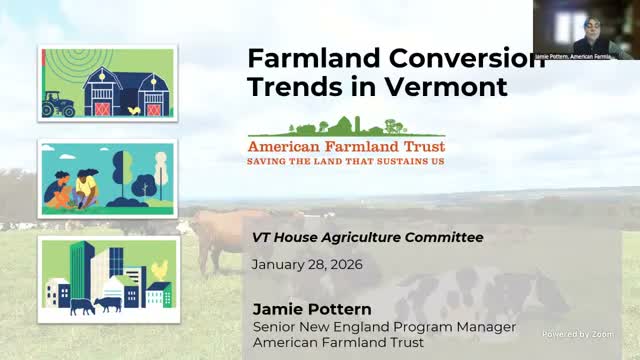
Summary
Jamie Potter of American Farmland Trust told the committee AFT's ground‑truthing found Vermont converted 19,832 acres of farmland from 2016–2023, with 76% of that conversion into low‑density residential development and hay fields accounting for the largest single category of loss.
Jamie Potter, senior New England program manager for American Farmland Trust (AFT), presented new AFT analysis to the Agriculture, Food Resiliency, & Forestry committee showing farmland conversion in Vermont is occurring faster than earlier projections.
"From 2016 to 2023, Vermont has already converted 19,832 acres of its farmland," Potter said, adding that the ground‑truthing covers the first seven years of AFT’s Farms Under Threat 2040 projections. Potter said that amount represents about 48% of the acreage AFT had projected would be lost by 2040 under a business‑as‑usual scenario and that conversion is happening roughly 65% faster than the original projection.
Potter summarized AFT’s scenario results: under business‑as‑usual AFT projected about 41,000 acres of conversion to 2040; a ‘‘runaway sprawl’’ scenario projected nearly 62,000 acres; and a ‘‘better built towns’’ scenario projected a little over 21,000 acres. She said most recent conversion has gone into low‑density residential development (about 76%) and that hay fields account for over 12,000 acres of the observed 2016–2023 conversion.
Potter said AFT ranked Vermont fifth nationally for policy responses in its land‑protection scorecard and emphasized the need to accelerate land protection, address farm viability and support succession planning. She also noted a number of drivers: an aging farmer population (nearly 40% of producers over age 65), high land and housing costs limiting access for new and beginning farmers, and climate‑related shocks that have stressed farm operations.
Committee members asked technical questions about AFT’s methods (how partial lot conversion is counted) and about whether dual‑use solar is treated as farmland loss. Potter said ground‑truthing used national land‑cover and crop‑layer datasets and that AFT supports ‘‘smart’’ or dual‑use solar that avoids permanent displacement of productive acres; she offered to follow up with her research colleagues and to send links and datasets to committee staff.
The presentation concluded with committee discussion of policy options including zoning, targeted land protection and strategies to make farming more financially viable for the next generation of farmers.