Lifetime Citizen Portal Access — AI Briefings, Alerts & Unlimited Follows
Lakeville panel approves restoration plan for wetland behind 52 Clearpond Road
Loading...
Summary
The Lakeville Conservation Commission approved a conditional wetland restoration plan for 52 Clearpond Road in response to an enforcement order, requiring updated plan language, agent/wetland-professional oversight and submission to Natural Heritage; work will include removal of accumulated wood chips and two years of monitoring.
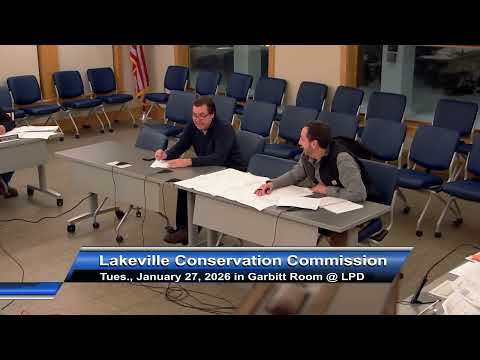
Nancy Yates, chair of the Lakeville Conservation Commission, said the commission voted Wednesday to approve a conditional restoration plan for the wetland behind 52 Clearpond Road following a long-running enforcement action.
Steve Schmiel, the consultant presenting the plan on behalf of property owner Derek (identified in the record as the property representative), told the commission the proposal responds to an enforcement order issued in June 2025 for unauthorized dumping and filling. Schmiel said the plan calls for restoring roughly 26,000 square feet of bordering vegetated wetland and about 12,000 square feet of buffer zone, removing accumulated wood chips, replanting native trees and shrubs and installing a semipermanent barrier at the lawn edge to prevent future encroachment.
The commission pressed for clearer plan language and oversight. Mark Minton, the Lakeville conservation agent, was identified in the plan as the agent responsible for authorizing planting and seeding; commissioners asked that authorization occur in concert with a wetland professional rather than leaving final sign-off solely to the agent. Schmiel agreed to update the narrative and plan notes to explicitly require a wetland professional to supervise on-site work and to include the agent in milestone reviews. The commission also required the consultant to submit the full enforcement package to Natural Heritage so the state program can comment on potential species or habitat concerns.
Schmiel described field work completed as part of the plan: a sampling and test-trenching program carried out Aug. 29, 2025, to expose subsoils. He said test pits found as much as 4–6 feet of wood-chip material in places, and that the team would use an excavator with a smooth (no-teeth) bucket to remove material linearly from the western wetland edge eastward. Samples and photos will be included in a summary report; the plan also calls for monitoring reports each growing season for two years (fall 2026 and fall 2027) and a final determination on whether performance standards have been met before closing the enforcement action.
Commissioners and the applicant discussed logistics: how to avoid harming tree roots during excavation, whether equipment mats would be needed, and how much of the wood-chip material must be removed versus left in place to decompose and aid restoration. Schmiel said crews will avoid over-digging, will hand-rake around trees where necessary, and do not intend to remove every trace of wood chips when doing so would damage native soils.
The commission also raised the photographic observation that the fill appears to extend onto an adjacent property. Schmiel confirmed some material extends beyond the 52 Clearpond Road property line and said he had discussed access with the neighbor; the commission recommended filing a Request for Determination (RDA) or otherwise securing permission to perform work on the adjacent parcel if removal is required there. The enforcement order in the record applies to 52 Clearpond Road only.
John LeBlanc moved to approve the restoration plan “subject to some slight changes to the plan language” and to forward the package to Natural Heritage; the motion was seconded and approved by voice vote. The commission directed the applicant to provide an updated plan of record that reflects the agreed changes and to schedule on-site milestone reviews with the agent and a wetland professional before planting.
The applicant said cleanup could begin 'anytime soon' depending on weather and permitting, and that he would circulate an updated plan and schedule once the changes were made and any necessary permissions for neighboring work were secured. The enforcement action will remain open until monitoring demonstrates the restoration meets performance standards.