
Subcommittee advances bill to rejoin RGGI after wide debate on costs and benefits
Get AI-powered insights, summaries, and transcripts
Subscribe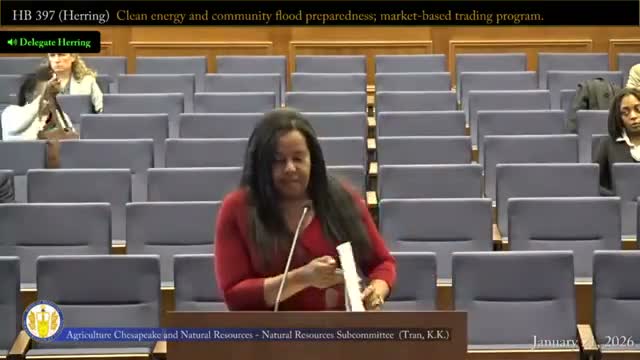
Summary
HB 397 would direct DEQ to take steps for Virginia to rejoin the Regional Greenhouse Gas Initiative; supporters emphasized pollution reduction and dedicated funding for weatherization and flood resilience, while manufacturers and energy groups warned of costs passed to ratepayers; the subcommittee reported the substitute 6–3.
Delegate Herring presented HB 397, a substitute that would direct the Virginia Department of Environmental Quality and the state board to establish and maintain a market-based trading regulation consistent with RGGI to reduce CO2 emissions from electricity-generating units. The substitute clarifies departmental and board responsibilities and makes technical revisions to existing code sections.
Supporters — including the Southern Environmental Law Center, local governments, and conservation organizations — said rejoining RGGI reduced pollution, funded resilience and weatherization programs, and provided a predictable revenue stream for community flood preparedness and energy-efficiency investments. Nate DePenferrato of the Southern Environmental Law Center said the substitute clarifies existing law and would help Virginia rejoin RGGI quickly. Jay Ford of the Chesapeake Bay Foundation highlighted the return on investment from resilience spending funded by auction proceeds.
Opponents — including the Virginia Manufacturers Association, the Virginia Chamber of Commerce, the Virginia Oil and Gas Association and other business groups — raised affordability and competitiveness concerns. Brett Vassy (VMA) argued the measure effectively functions as a tax on electricity and warned of potential performance-audit gaps for how auction proceeds are spent. Industry lawyers and associations noted utilities’ regulatory mechanisms can pass costs to consumers and cited estimated historic bill impacts.
Committee debate highlighted competing priorities: environmental benefits and dedicated revenue for resilience versus concerns about higher energy bills for households and businesses. Some members sought assurances around transparency and audit requirements for auction proceeds; others emphasized the program’s record of funding flood preparedness and weatherization grants. Delegate Herring and supporters cited specific community investments funded earlier by RGGI proceeds.
After recorded roll-call, the subcommittee voted to report the substitute to the full committee by a 6–3 margin.