Staff briefing outlines tuition, aid and athletics pressures in Virginia higher education
Loading...
Summary
House Appropriations staff analyst Tony Maggio briefed the subcommittee on higher education finance, highlighting fund-split mechanics, tuition trends, increased institutional use of tuition for aid, student debt statistics, and athletics cost pressures from NIL and conference realignment.
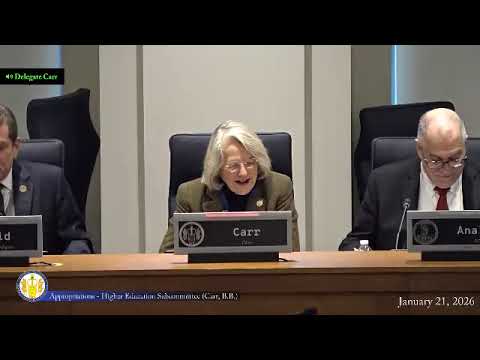
Tony Maggio, staff analyst for higher education in the House Appropriations office, delivered an extended briefing to the Education Subcommittee summarizing the state of higher education finance and policy questions lawmakers are likely to face this session.
Maggio framed higher education funding into three primary buckets — Educational & General (E&G), auxiliaries (student fees, housing, dining, athletics) and sponsored programs (federally funded research) — and said the subcommittee would focus primarily on E&G, where general fund support matters most. He described the "fund split" (the share of an institution's budget supported by the state general fund) as largely a function of the proportion of in-state students and cited a 67% in-state target as a policy benchmark used in prior work.
Using examples presented to the committee, Maggio said the Virginia Community College System (VCCS) has a fund split near 64% driven by very high in-state enrollment, while UVA's fund split was shown around the low 30s with roughly 55% in-state students — illustrating how student mix shapes state subsidy allocations. He also noted that community-college enrollment has declined roughly 16% since 2009, which raises per-student unit costs at two-year institutions.
On financial aid, Maggio walked members through grants (Pell, state programs such as the Tuition Assistance Grant, or TAG) and loan programs (Stafford, PLUS and private loans). He discussed federal changes that introduced a Student Aid Index (SAI) cap that could affect Pell eligibility for some families, and presented national student-debt figures as reported in the briefing (approximately $1.8 trillion in outstanding student debt across ~43 million borrowers, with an average federal debt near $40,000). Maggio cautioned that some reforms in federal law and loan policy may significantly affect graduate borrowers and program-level eligibility rules.
Maggio also addressed the growing practice of institutions using tuition revenue to fund institutional grants for other students — a trend he said has expanded sharply since 2012 — and posed questions about the sustainability of high internal redistribution rates, particularly at institutions where a large share of tuition is reused to subsidize other students.
On athletics, Maggio reviewed auxiliary accounting and the consolidated "comp fee" that funds athletics allocations. He recounted the 2015 reform commonly referred to in the briefing as the "Cox" bill (HB 1897), which established athletics subsidy caps calibrated to institution/division groups and required annual APA review. Maggio said the last two years have seen fee growth (about 3.1% in his presentation) driven in part by name, image and likeness (NIL) developments, NCAA settlement terms, and conference realignment — and he highlighted the uneven distribution of TV and settlement revenues across conferences as a key driver of disparate institutional positions.
Maggio closed by recommending the subcommittee consider policy options such as continuing base funding provided last session for workforce priorities, outcome-based allocations tied to workforce production, evaluating limits on institutions' use of tuition for internal aid, and reviewing waiver programs that represent foregone revenue. He also called attention to new NCAA settlement mandates (including expanded mental-health requirements for athletes) and suggested the subcommittee could consider allowing related costs to be reflected in athletics subsidy calculations, with the Department of Accounts/APA managing the details.